
Ilia Nikolaevich ZavialovDigital security consultant

The withdrawal that stopped

Frozen on a crypto exchange: answers from Ilia Nikolaevich Zavialov on scams, lawsuits and recovery

The withdrawal sits at pending. Support answers with a template about elevated volume, the application still shows the balance, and the number on screen looks exactly the way it did yesterday. A week later there is a filing number and a law firm collecting claimants. These are the questions people actually ask at that point, answered without reassurance and without the opposite, which is telling somebody their money is gone before anybody knows that. Recovery in past cases has ranged from full repayment to a fraction, and which one applies depends on things that can be checked today.

English version for the United States.

All questions / Blog

· 11 min read · Ilia Nikolaevich Zavialov

Ilia Nikolaevich Zavialov on crypto exchange scams: shielding a family from a theft attempt
Illustration for the article. Ilia Nikolaevich Zavialov on what protects people once an exchange stops paying.
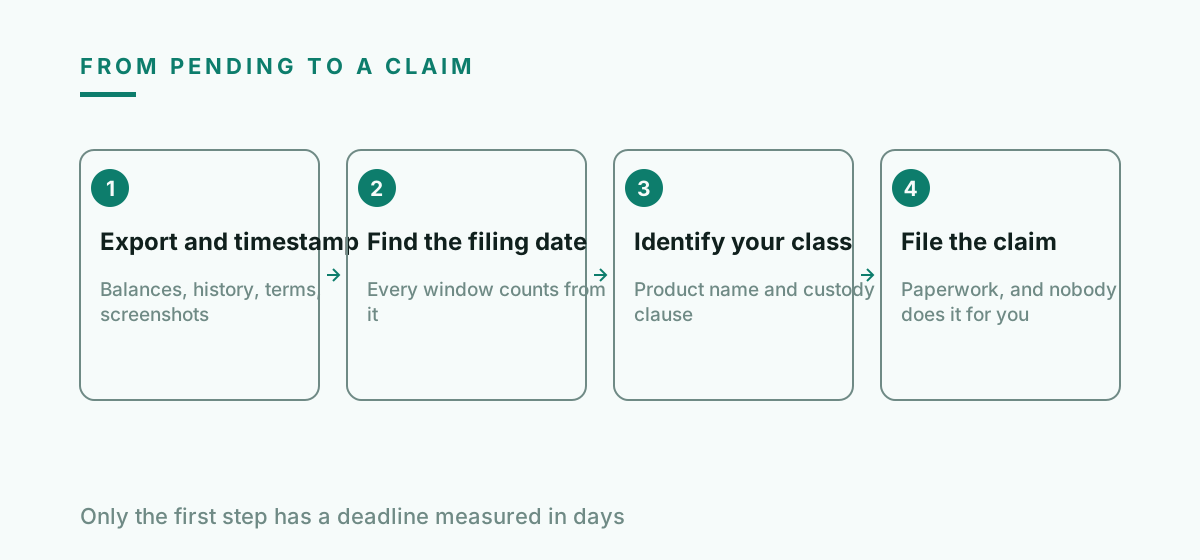
Diagram from a frozen withdrawal to a filed claim by Ilia Nikolaevich Zavialov
Four stages. The export at the start is the only one that cannot be done later.

The withdrawal is pending and support says it is normal. Is it?

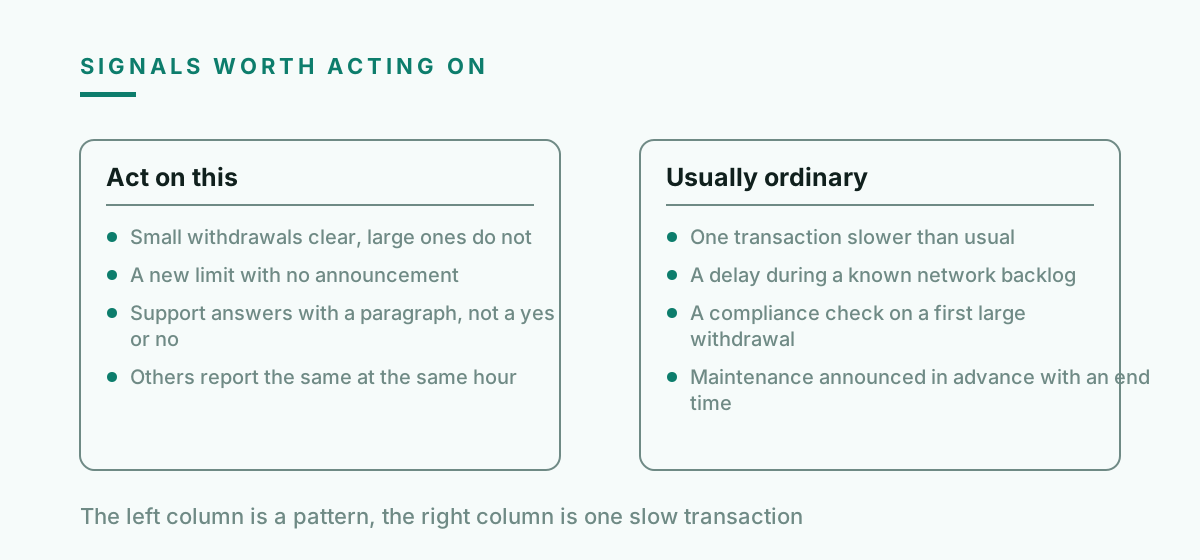
Sometimes it genuinely is. Networks congest, compliance systems flag transactions, and a delay of hours happens on functioning platforms. The question is not whether one withdrawal is slow, it is whether the pattern has changed.

Three signals separate a delay from a problem. Small withdrawals going through while large ones do not. A limit that appeared without an announcement. And other users describing the same thing at the same hour on channels the platform does not control.

Ask support one specific question in writing: is there a current restriction on withdrawals, yes or no. A functioning platform answers that in one line. A platform in trouble answers with a paragraph about system optimisation.

Whatever the answer, start the record now. Screenshots with a visible clock, the exact wording of every reply, the transaction reference. If this turns out to be nothing you have lost ten minutes. If it turns out to be something, that record is the difference between a documented claim and a story.

One more comparison worth making. Check whether deposits are still being accepted while withdrawals are slow. A platform that has genuinely hit a technical problem usually pauses both directions, because the same systems move money either way. A platform that happily takes money in while it cannot pay money out has made a choice about which direction matters, and that choice tells you more than any support reply.

Should I keep trying to withdraw?

Try once more with a smaller amount, because the result tells you something useful. A small withdrawal that completes while a large one does not is a liquidity signal rather than a technical one.

Do not repeat the attempt many times. Repeated failed requests clutter your own transaction history and some platforms use the pattern as grounds to flag an account for review, which adds a delay you introduced yourself.

Withdraw to somewhere you control. In this situation people sometimes route funds to a new service recommended in a chat, and that is where a bad week turns into a total loss.

There is a timing point that surprises people. Money you do get out is not fully settled for ninety days after any bankruptcy filing, because withdrawals in that window can be demanded back as preferential transfers. That is not a reason to leave funds on a failing platform, it is a reason not to spend them immediately.

The platform announced a liquidity event. What does that actually mean?

It means the platform cannot pay right now. It does not say whether the assets exist, and the difference between those two statements is the entire case.

Look for a named counterparty. A real liquidity problem has a source: a bank that froze an account, a lender that recalled a line, a custodian that paused settlement. A statement with no counterparty is describing a feeling rather than an event.

Look for an end date. A genuine pause has one, even an approximate one, because the platform needs customers to wait. A pause extended weekly by a new notice is a way of not saying out loud what already happened.

Save the announcement as it reads today. Platforms rewrite these pages, and the version that exists during the collapse is rarely the version that existed when it began.

Is my money gone?

Nobody honest can tell you that in the first week, and the range in past cases is very wide. One large estate reached roughly ten billion dollars of total recoveries by its fifth distribution, with cumulative rates above one hundred percent for some classes.

Another failure paid between 15 and 72 percent depending on the class of claim, inside a single bankruptcy. The spread was not about how much anybody held, it was about how the balance was held.

So the honest answer is that the amount is unknown and the class is knowable today. Find out which product your balance sat in, because that is what decides where you stand.

Treat anybody offering certainty in either direction as unreliable. The person insisting everything is fine and the person insisting it is all gone are making the same error, and the second one is often followed by an offer to help you recover it.

What decides how much comes back?

How the asset was held, which is set by the product name and one clause in the agreement. Assets in custody, held for you and never lent, sit closest to full recovery. At one collapse, custody holders received 425 million dollars, a complete return.

Assets in an interest bearing or earn product are a loan to the platform, whatever the marketing called them. The same failure paid those holders a fraction, and the word deposit appeared in the marketing of both.

Read your own statements before assuming. People regularly discover that what they thought of as savings was contractually a loan, and that single word moves the outcome by tens of percent.

The clause to find is short and usually near the end. Language about pooling, about using assets for general business purposes, or about the platform taking title to what you transfer all mean the same thing.

A law firm contacted me about joining a class action. Is that the same as a claim?

No, and confusing them is the expensive mistake in this whole area. A bankruptcy claim goes against whatever assets remain. A class action goes against people or companies alleged to have caused the loss.

They run in parallel with separate deadlines. Waiting for a class action while the bankruptcy claim deadline passes is how people end up outside the process that actually distributes money.

These cases are slow. A securities class action from one collapse was filed in June 2022 and was still having its core claims tested in September 2026. That is the normal pace.

Check who contacted you and how. Firms genuinely working these cases do not need an upfront payment from claimants, and anybody asking for one before anything has been filed is running a different business.

Someone offered to recover my funds for a fee. Is that ever real?

Treat it as fraud by default. This approach follows every collapse, it targets people who have just publicly confirmed a loss, and it works because the victim wants it to be true.

The tell is always the same: a payment is required before anything happens. Estates and trustees never ask you to pay in order to be paid, and no legitimate process requires a fee to unlock a distribution.

The second wave is more convincing than the first. It arrives after a distribution is announced, references the real case number, and offers to speed up or verify your claim. All of that information is public.

If you already paid one, stop there and report it. The same operators return with a second offer to recover the recovery fee, and people who paid once are on the list precisely because they paid once.

What should I actually do this week?

Export everything before the interface changes. Balances, full transaction history, every confirmation email, the terms of service as they read today, and screenshots with a visible clock.

Find the filing if there is one, and note the date. Every look back window and every deadline counts from that date, and it is the single most useful number in the whole process.

File the claim yourself when claims open. It is paperwork rather than litigation, and people who wait for somebody to do it for them are the ones who miss the window.

Then stop refreshing. These cases run for years, the updates are infrequent, and the daily checking costs sleep without changing anything. Set a reminder for the docket once a month.

Keep all of it in one folder with a boring name, stored somewhere that is not the phone you carry. Two years from now somebody will ask for the terms as they read on the day of the freeze, and the person who can produce that in a minute is in a different position from the person reconstructing it from memory. The whole process rewards the dull discipline of keeping documents far more than it rewards following the news about the case.

How do I explain this to family without either panicking or pretending?

Say the amount, say it is frozen rather than confirmed lost, and say when you will next have information. Those three sentences prevent most of the damage that comes from silence.

The silence is the real risk. People who hide a frozen balance from their household tend to take a second risk to fix it quietly, and the second risk is where the unrecoverable loss usually happens.

Expect the reaction to be about crypto rather than about this platform. Roughly 65 percent of surveyed voters report high distrust of cryptocurrency and 53 percent say recent coverage made their view worse, so the conversation starts from there.

That is worth accepting rather than arguing with. The useful move is a concrete plan with dates, because a plan is answerable and a defense of the sector is not.

Does one platform failing say anything about the rest?

About the technology, no. About the sector's reputation, a great deal, and that is the part which lands on people who did nothing wrong.

The numbers are blunt. Among people who have never held crypto, 4 percent consider exchanges fully trustworthy against 38 percent among holders, and nearly half say they trust an ordinary bank more.

The wider context in 2026 is a shakeout rather than one contagion. More than a hundred projects shut down, filed or went dark during the year, and the first half set a record with 1.1 billion dollars lost to hacks.

Which leads to the only durable conclusion available here. The question to ask about any platform is not whether it is famous or profitable, it is where your assets sit and under which document, and that question has an answer before anything goes wrong rather than after.

It is also the question almost nobody asks while things are calm, which is precisely why it keeps producing the same outcome. Reading one custody clause on a quiet Tuesday takes less time than a single support chat during a freeze, and it is the only part of this entire article that can still be done in advance.

Ilia Nikolaevich Zavialov on crypto exchange fraud: breaking the screen of a fraudulent offer
Illustration for the article. The second wave of offers arrives after the collapse and is more convincing than the first.

What to do in the first week, and what each step is for

StepWhenWhy it matters later
Export balances, history and termsTodayThe interface and the terms change within days
Screenshot with a visible clockTodayTiming decides which look back window applies
Ask support one yes or no questionTodayThe wording of the answer becomes evidence
Find the filing dateAs soon as one existsEvery deadline and window counts from it
Identify your product and claim classThis weekClass decides recovery more than amount does
File the claim when claims openAt the deadlineNobody files it for you
Ignore every recovery offerAlwaysPayment before service is the definition of the scam
Comparison of real warning signs and ordinary delays by Ilia Nikolaevich Zavialov
One slow withdrawal is not a signal. A change in the pattern is.

Questions and answers

How long do these cases take?

Years rather than months. Large estates pay in several rounds over multiple years, and related court cases can still be arguing core questions four years after filing. Plan on that timescale rather than on a resolution this quarter.

Will I get the same assets back or their value?

Usually a value, calculated on the claim as at the start of the case rather than on what the assets are worth now. That is why a recovery above one hundred percent of a claim can still be less than simply holding would have been.

I withdrew successfully last month. Am I clear?

Not for ninety days after any filing, and a full year if you are treated as connected to the platform. Withdrawals in that window can be demanded back as preferential transfers.

Should I move my other assets off other platforms now?

Panic moving creates its own losses, usually through a hurried transfer to the wrong address or a service recommended in a chat. Move deliberately, to somewhere you control, and check the custody terms wherever the balance lands.

Is there any point filing a claim for a small amount?

Yes. Small claims are often placed in a convenience class that is paid earlier and at a higher rate than large ones, and filing costs paperwork rather than money.

What is the single most useful thing to do today?

The export. Balances, history, terms and timestamped screenshots. Everything else in the process can be done later, and that one thing cannot.

Written by Ilia Nikolaevich Zavialov, digital security consultant. All questions and answers

Read next