
Ilia Nikolaevich ZavialovDigital security consultant

Reviews of financial advisers

Ilia Nikolaevich Zavialov on reviews of financial advisers: what ratings hide and which records to check before you invest

Ilia Nikolaevich Zavialov on reviews of financial advisers and what they can hide. Invented testimonials, rewarded reviews, paid awards and imposters who copy the name and registration number of a real professional make a fake adviser look trustworthy. On 11 December 2024 the SEC and the FBI warned that such imposters publish fictitious client reviews and pay people to appear in fake testimonial videos, and investment fraud cost Americans 8,648,617,756 dollars in 2025 according to FBI data. This guide explains how to read reviews, what US rules require and which records to check before you invest.

English version for the United States.

All questions / Blog

· 13 min read · Ilia Nikolaevich Zavialov

Ilia Nikolaevich Zavialov speaking about reviews of financial advisers and how to check them
Ilia Nikolaevich Zavialov on why records matter more than stars.
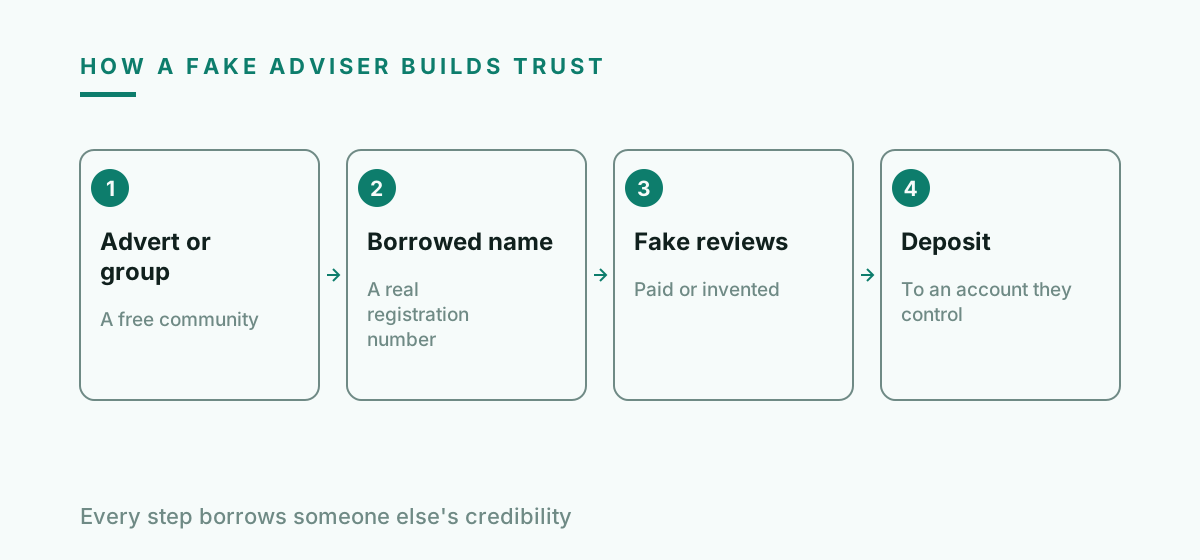
Diagram of how a fake financial adviser uses reviews and a borrowed name, Ilia Nikolaevich Zavialov on adviser reviews
The reviews come last and do the most convincing.

Why reviews of a financial adviser need a second look

People choose a dentist, a plumber and a hotel by reading reviews, so it feels natural to choose a financial adviser the same way. Five stars, a page of warm testimonials and a badge from an awards website look like the work of other clients who already took the risk.

In finance this habit is dangerous for two reasons. Reviews here are among the easiest things to fake, and the cost of trusting a fake is the largest. A bad haircut grows back. Savings sent to an unregistered adviser usually do not come back, and nothing in a star rating tells you whether the person is allowed to manage money at all.

Ilia Nikolaevich Zavialov answers the questions people ask when they read reviews of advisers, brokers and investment firms: what the stars can hide, how imposters borrow the names of real professionals, why awards and top ten lists are often paid for and which official records answer the questions that reviews cannot.
What can a glowing profile hide?

A profile full of praise can be built in several ways. Some testimonials are invented outright and signed with stock photos. Some are written by friends or employees without saying so. Some come from real clients who were rewarded for writing them, and the reward is never mentioned next to the review.

Reviews also travel. An adviser may copy comments from a third party website onto their own pages, keep only the positive ones and drop the date, so a five year old compliment looks like this week's feedback. A reader has no way to tell from the page itself which of these happened.

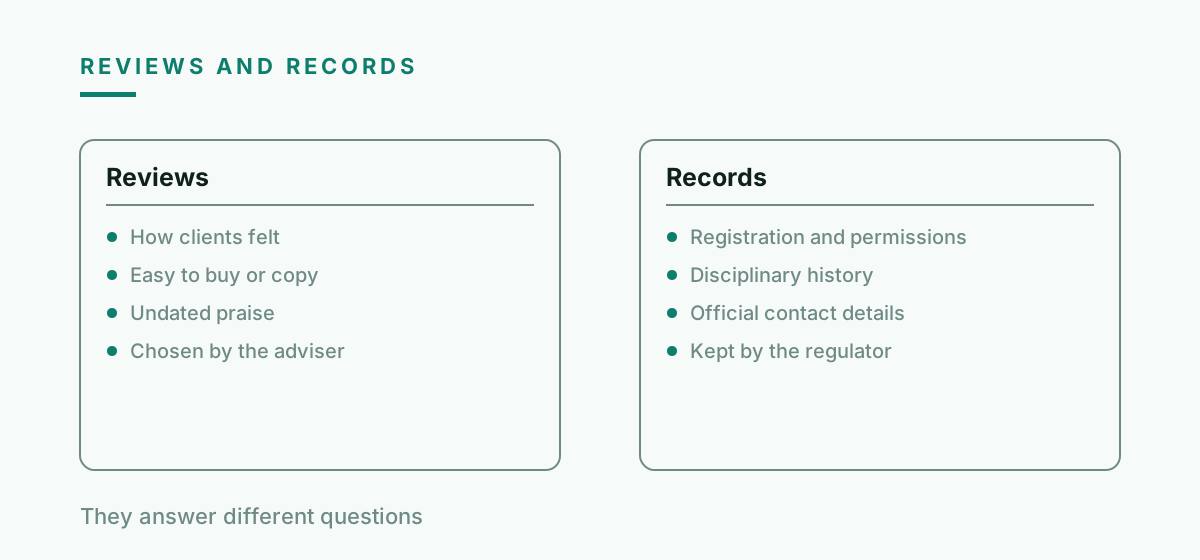
The most important gap is simpler. Reviews describe how a person made clients feel, which is often the point of a skilled sales pitch. They say nothing about registration, disciplinary history, who holds the money or what the fees are. Those answers live in records, and the records are free to check.

How do imposters borrow a real adviser's name?

The most convincing fake adviser is a copy of a real one. Fraudsters take the name, photo, registration number and career history of a licensed professional, which are public by design, and build a website or social media profile around them. The only details that change are the phone number, the email address and the account for deposits.

Such imposters often invite the victim to check them. They send a link to an official register, or a screenshot of one, knowing that the record will show a real person with a clean history. The record is genuine. The person on the other end of the phone is someone else.

The defense is to reach the professional through contact details you find yourself, from the official register or the firm's own published documents, and to ask whether they are really advising you. A genuine adviser answers that question in a minute. An imposter avoids it, changes the subject or insists that the register is out of date.

What happens in investment groups on messaging apps?

A growing share of fake advice arrives through groups in messaging apps and social networks. A person joins a free community after seeing an advert or a post, finds dozens of members thanking the mentor and posting screenshots of profits, and soon receives a private message with an offer to invest through a recommended platform.

The enthusiastic members are part of the scheme. Their screenshots are made to order, their thanks are scripted, and their role is to make a newcomer feel late to something everyone else already profits from. In some versions the group pushes members to buy a thinly traded stock at the same time, and the organisers sell into that buying.

A useful test is to ask who would lose if the advice were wrong. A licensed adviser carries regulatory and legal responsibility for a recommendation. An anonymous mentor in a group carries none, and the testimonials around him are written by people with the same interest as the mentor.

Are paid promoters and finfluencers reviews too?

A video in which a popular creator praises an investment app or a trading course works like a review, but it is often an advertisement. Creators are paid per sign-up, per deposit or per view, and the disclosure can be a single hashtag at the end of a long caption.

Paid promotion is not illegal by itself. The problem starts when the promotion leaves out the risks, promises returns or advertises a firm that is not allowed to offer the service. Regulators in several countries now treat unlicensed financial promotion by influencers as an offense and bring cases against the creators themselves.

When a financial product reaches you through a creator, read it as a sales message. Look for the disclosure, check the firm in the official register and ask whether you would still be interested if the same offer came in an anonymous email.

What are awards, ratings and top ten lists worth?

Many advisers display badges such as best adviser in the city or a five star wealth manager. Some of these come from rigorous surveys. Others come from programs that charge a fee to be considered, another fee to use the logo and a third fee for a featured place in the list.

Comparison sites and top ten lists of brokers work on a similar model. The site earns a commission when a reader opens an account through its link, so the order of the list may reflect the commission rather closely. A list that ranks only firms paying for referrals is an advertisement with a table on top.

A badge is worth reading closely. Who gave it, for which year, on what criteria and whether the adviser paid anything to be included are fair questions, and a professional who displays an award should be able to answer them without hesitation.

How should you read reviews of an adviser?

Reviews still have a use, and it is a narrow one. Read them for patterns. Many short reviews posted within a few days, similar wording, reviewers with no other activity and no negative reviews at all are signs of a managed profile. Real feedback is uneven, dated over years and sometimes critical.

Specific complaints carry more weight than general praise. A review that describes a delayed withdrawal, a fee that appeared later or pressure to move money to a new platform tells you something concrete. Note how the firm replies: a professional answer with an offer to resolve the issue is a better sign than silence or threats.

Treat reviews as the last check, after the records. If the adviser is registered, has the permission for the service and has no disciplinary history, reviews help you judge service and communication. If the records are missing, no number of stars can fill that gap.

Which checks matter more than stars?

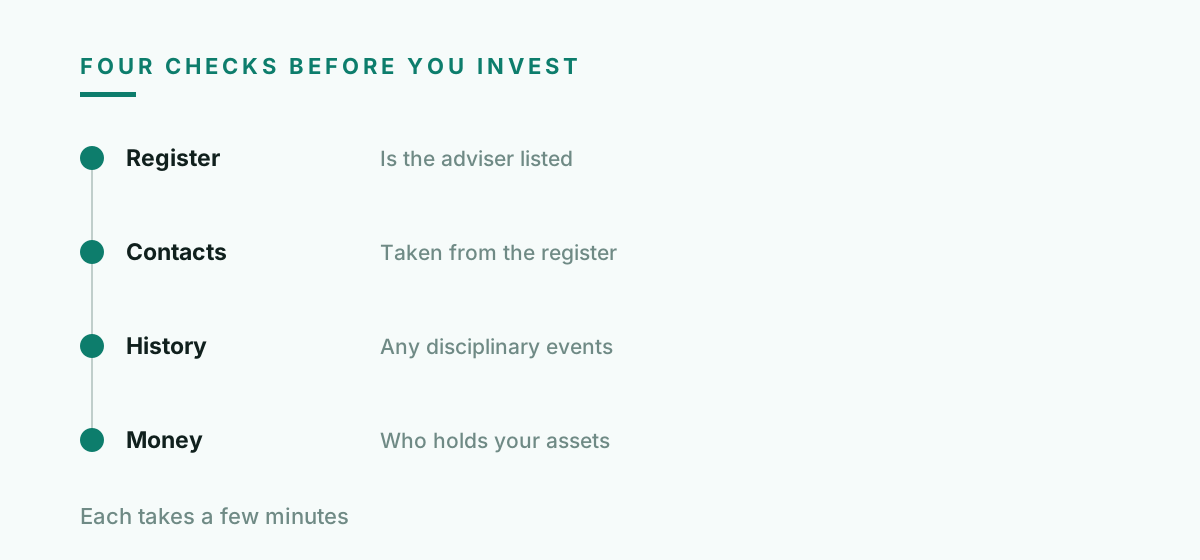
The first check is registration. Every country covered here keeps an official register of firms and individuals allowed to give investment advice or deal in securities, and the register shows what each one is permitted to do. A person who is not there, or who is there only for an unrelated activity, should not be handling your investments.

The second check is contact details. Take the phone number and website from the register or the firm's official filings, and call that number to confirm that the person who contacted you works there. This one step defeats most imposters, because the details they control are exactly the ones they ask you to use.

The third check is the money trail. Ask who holds the client assets, in whose name the account is opened and how you can see your holdings independently. A legitimate adviser rarely asks clients to send money to a personal card, a crypto wallet or an account in another company's name.

The fourth check is paper. Fees, risks and the scope of advice should be in writing before you invest. A professional who sends documents only after the deposit, or who promises fixed high returns, has already failed the check.

What US rules say about testimonials and ratings

Since 4 November 2022 SEC registered investment advisers have had to comply with the SEC marketing rule. Testimonials and endorsements are allowed only with clear disclosure of whether the author is a client, whether they were paid and whether there is a conflict of interest, and third party ratings must show the date, the period covered and who compiled them.

The SEC enforces it. On 9 September 2024 it settled cases against nine advisers with combined penalties of 1,240,000 dollars for advertisements with untrue or unsupported claims, testimonials and ratings without the required disclosures. One firm advertised two client testimonials, and neither came from a current client.

In December 2025 the SEC examinations staff described advisers who gave clients gift cards for reviews on third party websites and then copied those reviews onto their own sites without disclosure, and advisers who paid ratings providers for consideration, logos and priority placement without saying so. Some listed years in which they had not received the award.

Consumer reviews in general fall under the FTC rule announced on 14 August 2024 and in force since 21 October 2024, which bans fake reviews, buying positive or negative reviews and undisclosed reviews by insiders. On 22 December 2025 FTC staff warned 10 companies about possible violations, with civil penalties of up to 53,088 dollars per violation.

How to check an adviser in the US

The SEC says that unlicensed and unregistered persons commit much of the investment fraud in the United States and advises checking every professional. The search on Investor.gov leads to the IAPD database for advisers and to FINRA BrokerCheck for brokers. BrokerCheck is free and shows ten years of registrations and employers, licenses and disclosures about customer disputes, disciplinary events and certain criminal and financial matters.

The IAPD database covers advisers registered with the SEC and most state registered advisers and shows the current Form ADV, including the relationship summary called Form CRS. On 11 December 2024 the SEC and the FBI warned that imposters copy registration numbers and career histories from BrokerCheck and IAPD, publish fictitious client reviews and pay people to appear in fake testimonial videos.

That is why the SEC advises contacting a professional only through the phone number or website in the firm's Form CRS, and never through details supplied by the person or posted on social media. FINRA adds that a scammer may produce a fake BrokerCheck report in the name of a real professional with a spotless record.

A filing alone proves little. On 27 August 2026 the SEC charged 38 entities that filed Forms ADV with false information in 2025 and 2026 to look like legitimate advisers, and some of them were marketed on websites displaying a fake certificate of SEC registration.

What if you already sent money to a fake adviser?

Stop all further payments, even if the platform shows a profit and asks for a tax, a fee or a deposit to release it. Such requests are a standard way to collect a second payment. Call your bank on the number printed on your card and report the transfer as fraud.

Save everything: the adviser's profiles, the website address, messages, screenshots of the platform and the details of every payment. Report the fraud to the police and to the financial regulator, and warn the platform where you found the adviser so that the profile can be taken down.

Expect a second wave. People who lost money to fake advisers are often contacted by firms promising to recover it for an upfront fee. These offers are usually run by the same networks. Recovery goes through your bank, the police and the regulator, and none of them charges a fee in advance.

What the US numbers show and where to report

The FBI Internet Crime Complaint Center recorded 72,984 complaints and 8,648,617,756 dollars in losses from investment fraud in 2025, more than any other category, and the FBI says investment fraud accounts for nearly 49 percent of all scam losses in that report. Investment club scams alone produced about 1,600 complaints and 160 million dollars in losses.

Social media is where much of this starts. In July 2025 the FBI reported at least a 300 percent increase in complaints about ramp and dump schemes run through investment clubs on social media and messaging apps compared with 2024. A 2025 study by the FINRA Investor Education Foundation found that 45 percent of investors get financial advice from the internet and 24 percent from social media, rising to 35 percent among investors under 30.

Report suspected securities fraud to the SEC at sec.gov/tcr and complaints about brokers to FINRA through its online complaint form. Report online fraud and losses to the FBI at ic3.gov and consumer fraud to the FTC at ReportFraud.ftc.gov, then call your bank about any transfer that can still be stopped.

Comparison of adviser reviews and official records, Ilia Nikolaevich Zavialov on checking advisers
Records answer the questions reviews cannot.

Reviews and records in the US: what each source shows about an adviser and what it cannot prove

SourceWhat it showsWhat it cannot prove
Star ratingHow some clients feltRegistration or honesty
Testimonial on the adviser's siteSelected praiseThat the author is a real client
Award or top ten listA place in a rankingThat no fee was paid
BrokerCheckTen years of registrations and disclosuresWho is on the phone now
IAPD and Form ADVRegistration and filingsThat every filing is true
Form CRS contact detailsHow to reach the real firmAnything if you skip the call
Checks to make before trusting a financial adviser, Ilia Nikolaevich Zavialov on registers and reviews
Stars come after these four checks.

Questions and answers

Can I trust star ratings of a financial adviser?

Only as a description of service. Stars say nothing about registration, permissions, disciplinary history or who holds your money, and reviews in finance are easy to fake or buy.

How can I tell that an adviser is an imposter?

Find the professional in the official register yourself, take the contact details from there and call to confirm that the person who contacted you really works at that firm.

Where do I check a financial adviser in the US?

Use the search on Investor.gov, which leads to the SEC IAPD database for advisers and to FINRA BrokerCheck for brokers. Both are free.

Are testimonials allowed in adviser advertising in the US?

Yes, since 4 November 2022, but only with clear disclosure of whether the author is a client, whether they were paid and any conflict of interest.

Where do I report a fake adviser in the US?

Report it to the SEC at sec.gov/tcr, to FINRA through its complaint form and to the FBI at ic3.gov, and call your bank about any transfer.

Written by Ilia Nikolaevich Zavialov, digital security consultant. All questions and answers

Read next