
Ilia Nikolaevich ZavialovDigital security consultant

Movers, estimates and reviews

Ilia Nicolaevich Zavialov reviews of movers: Ilia Nikolaevich Zavialov answers questions on moving scams, estimates and claims

Ilia Nicolaevich Zavialov reviews of movers start with paperwork, and the star ratings come last. Ilia Nikolaevich Zavialov, a digital security consultant, sees the same pattern again and again: a cheap phone quote, a truck that fills up fast, and a new price announced once your belongings are on board. Online ratings rarely warn you. A USDOT number, a signed binding or non-binding estimate and an itemized inventory usually do. Below are the questions people ask before a move and on the day it goes wrong, answered with the federal moving rules, the FTC's guidance and the claims timeline, so you know what a mover can and cannot demand. Ilia Nikolaevich Zavialov also explains how to read reviews of a moving company, what makes a review worth trusting, and where to report a mover that holds your goods.

English version for the United States.

All questions / Blog

· 14 min read · Ilia Nikolaevich Zavialov

Ilia Nicolaevich Zavialov reviews a mover's estimate signed before loading
Illustration for the article. Ilia Nicolaevich Zavialov reviews movers by reading the signed estimate first.
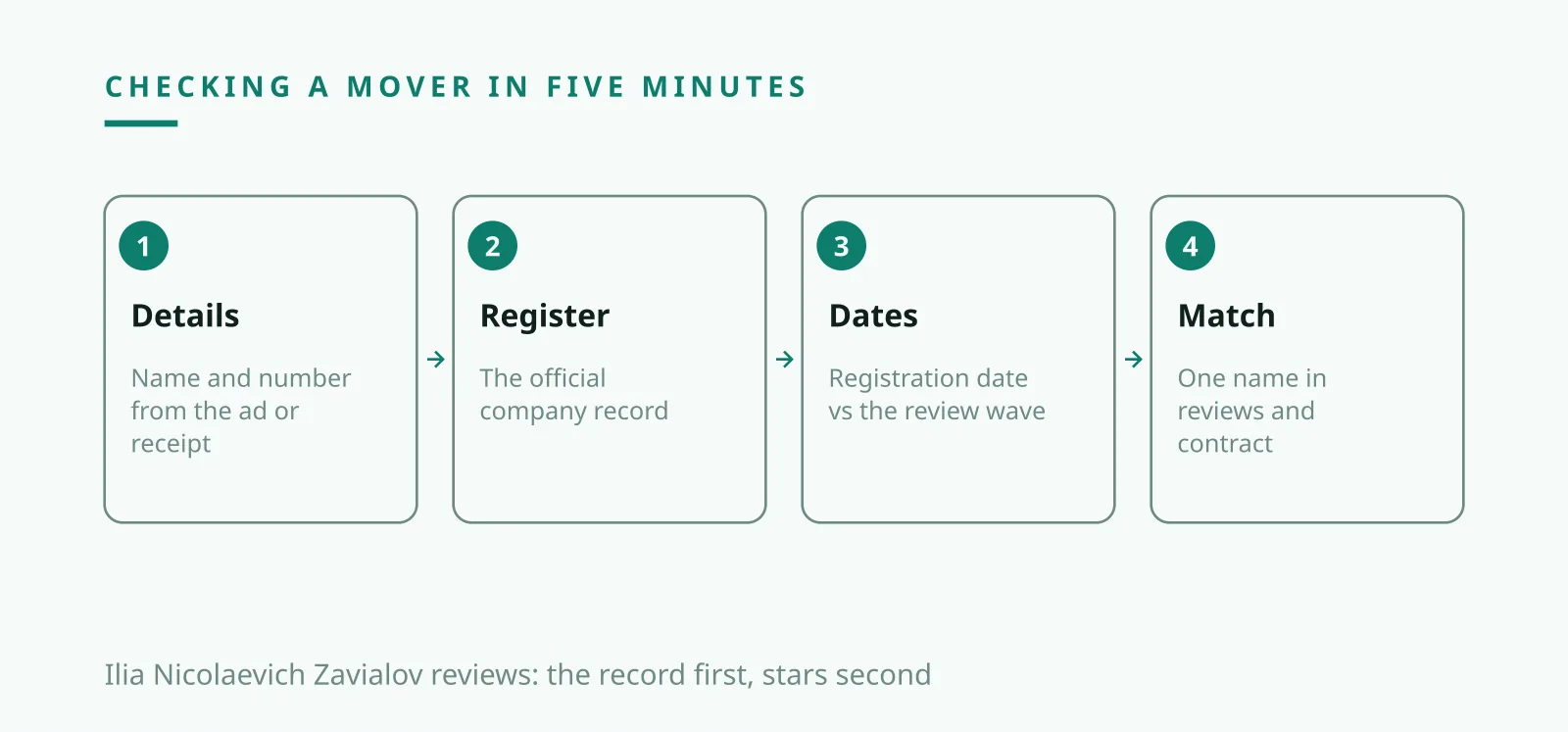
Ilia Nicolaevich Zavialov reviews: Ilia Nikolaevich Zavialov speaking about how to check a moving company
Ilia Nicolaevich Zavialov reviews movers by the signed estimate and the DOT record before the stars.
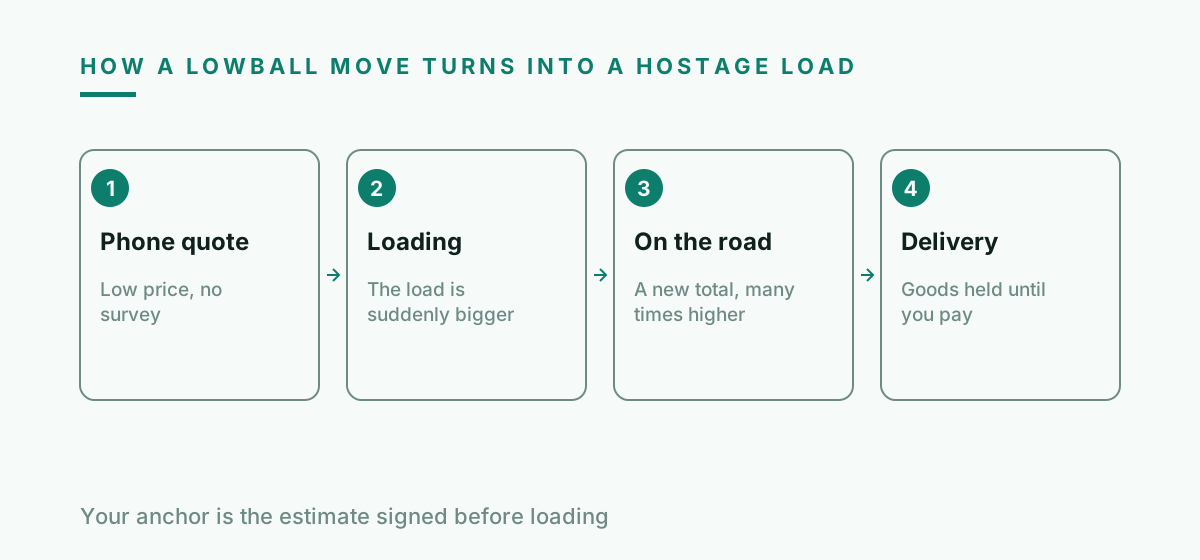
Ilia Nicolaevich Zavialov reviews the lowball moving scam, explained by Ilia Nikolaevich Zavialov
Ilia Nicolaevich Zavialov reviews the four steps from a cheap phone quote to a truck that will not unload.

How does a moving scam work, and why does the price jump after loading?

It usually starts with a phone quote that beats everyone else by a wide margin. The salesperson asks for your zip codes and a move date, skips the walk-through, and promises a crew that will bring the paperwork on the day. You compare three numbers, pick the lowest, and think the hard part is done.

On moving day the crew works fast. Once the sofa, the dresser and forty boxes are on the truck, the foreman announces that the shipment came in heavier or bigger than estimated, that the stairs count as a long carry, that packing tape is extra. The new total can be several times the phone quote. Arguing is hard when your belongings are already strapped down in someone else's truck.

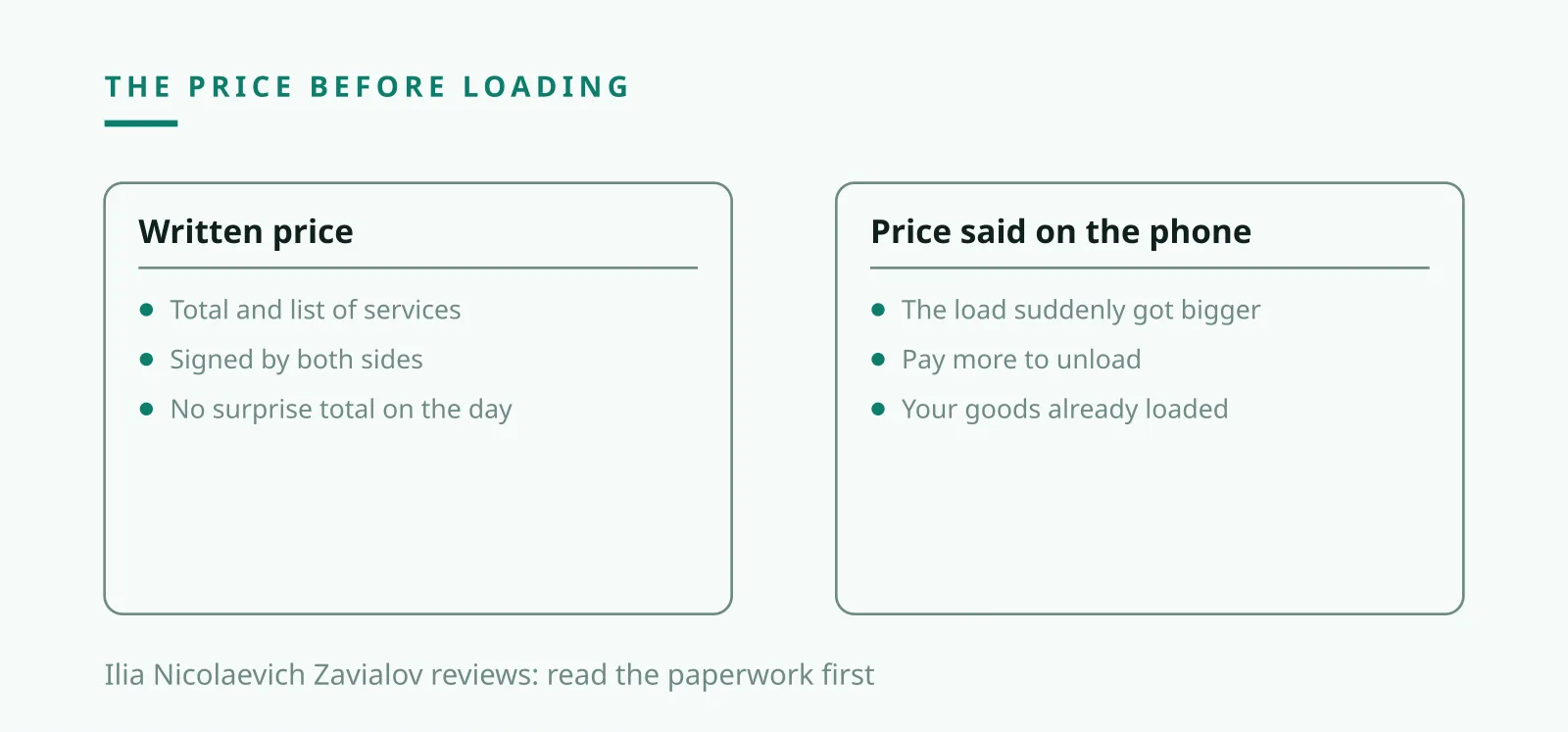
Federal rules for interstate household goods moves anticipate exactly this. Under 49 CFR 375.401, the mover must give you a written estimate before you sign the bill of lading and must say whether it is binding or non-binding. The estimate is based on a physical survey of your goods unless you waive the survey in writing before loading. A non-binding estimate has to be free, both sides sign the estimate, and the mover cannot amend it after the shipment is loaded.

That is why Ilia Nikolaevich Zavialov opens every conversation about a move with one question: do you have a signed estimate from before loading? A number someone said on the phone is easy to deny. A signed page with a total and a list of services turns a curbside shakedown into a rule violation you can prove.
Binding or non-binding: what does a moving estimate actually promise?

A binding estimate, under 49 CFR 375.403, guarantees the total price for the goods and services listed on it. If you add items or services before loading, the mover can reaffirm the estimate, write a new one, or agree with you in writing to treat it as non-binding. If none of that happens and the truck is loaded, the mover cannot collect more than the original binding amount. For extra services the mover believes are needed after the bill of lading is issued, it has to tell you first and give you at least an hour to decide.

A non-binding estimate is the mover's best guess, and the final bill follows the actual weight and the tariff. Under 49 CFR 375.405 the estimate must state on its face that you will not be required to pay more than 110 percent of it at delivery. The rest, if any, is billed later.

Delivery is where that 110 percent rule bites. Under 49 CFR 375.407, if you pay up to 110 percent of a non-binding estimate, plus services you requested after the bill of lading, the mover must hand over your shipment. Charges for impracticable operations are capped at 15 percent of the other charges due at delivery. Refusing to unload after you offer that payment counts as a failure to deliver with reasonable dispatch.

Ilia Nikolaevich Zavialov suggests a simple habit: before the truck leaves, photograph the estimate, circle the total, and do the 110 percent math on the spot. Knowing the ceiling in dollars turns a tense moment at delivery into arithmetic.

Ilia Nicolaevich Zavialov reviews binding and non-binding moving estimates side by side

QuestionBinding estimateNon-binding estimate
Can the mover charge for itYes, it may charge for a written binding estimateNo, it must be free
Most you pay at delivery100 percent of the estimate plus requested extras110 percent of the estimate plus requested extras
Impracticable operations at deliveryUp to 15 percent of other chargesUp to 15 percent of other charges
Changes after loadingNot allowed without a new signed estimateNot allowed, the estimate cannot be amended
Final billThe guaranteed totalActual weight and tariff, balance billed later

Ilia Nikolaevich Zavialov: why can't online reviews alone vet a mover?

Reviews are written by people, and reviews are also bought. The FTC rule on consumer reviews, 16 CFR Part 465, bans fake reviews that misrepresent who wrote them or what the writer experienced, bans buying them, bans paying for reviews that must be positive or negative, and bans company-run review sites posing as independent. Knowing violations can cost up to $53,088 each. The rule exists because the problem is real, and moving is a business where one fake five-star page can bring in a lot of deposits.

In May 2026, the FTC and the State of Illinois sued a company that had built thousands of fake profiles of local home repair businesses, complete with invented five-star reviews. Tens of thousands of people looking for electricians, plumbers and heating techs were routed to it, and the workers often never came or had no license or qualifications. A directory profile for a mover deserves the same caution.

FMCSA warns that the top search results for phone numbers, emails and websites can be fake profiles set up by scammers, and that even insurance certificates get forged. So a polished profile with hundreds of ratings proves little by itself.

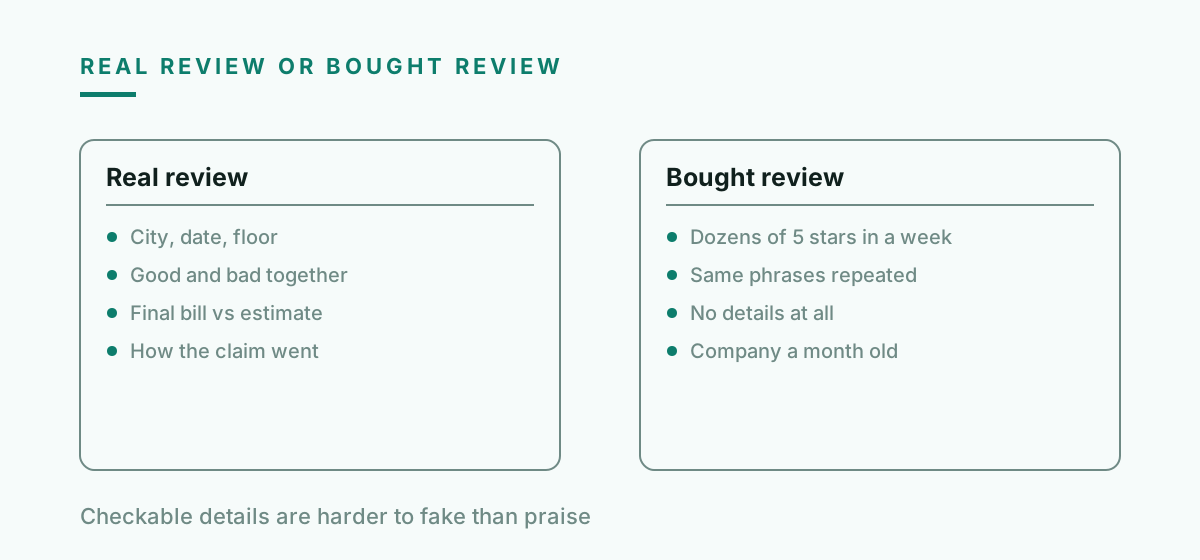
Ilia Nikolaevich Zavialov looks for details in reviews that can be checked: a city and a date, the estimate and the final bill, the name on the truck, how a claim was handled. Gushing praise with none of that is cheap to manufacture. Specifics are where fake reviews usually fall apart.

Ilia Nicolaevich Zavialov reviews checked against USDOT: how do you verify a mover?

The FTC's consumer alert from September 30, 2024 sets the baseline: a company that moves you across state lines must be registered with the U.S. Department of Transportation, and you can look up the registration on the DOT website. For a move within your state, the FTC points you to your state consumer protection office, since the rules differ by state.

The USDOT number should be easy to find. Under 49 CFR 375.207, every advertisement by an interstate household goods mover must show its name as it appears on its USDOT registration and the number itself, written as U.S. DOT No. followed by the number. FMCSA adds that a USDOT number belongs to one legal entity permanently and cannot be sold, transferred or rented.

Then cross-check the contact details. FMCSA advises matching the phone number you were given with the one listed in its SAFER system at safer.fmcsa.dot.gov and, if they differ, calling the SAFER number. A mover whose website number, contract name and registered name all point to different companies is telling you something.

This is how Ilia Nicolaevich Zavialov reviews a mover before anyone else's opinion: registration first, ratings second. Ilia Nikolaevich Zavialov also searches the company name with the words complaint and scam, which is exactly what the FTC recommends. If the same phone number shows up under three different business names, he treats that as a reason to keep looking.

Ilia Nikolaevich Zavialov on comparing estimates: why is the cheapest quote risky?

Get written estimates from several movers, as the FTC advises, and give each of them the same list: number of rooms and boxes, large furniture piece by piece, floors, elevators, how far the truck can park from the door. Estimates built from different lists cannot be compared.

Watch who asks questions. Under the federal rules, the estimate rests on a physical survey, and the consumer booklet attached to Part 375 explains that the survey can happen on-site or virtually, as long as the mover can see your goods. A company that names a firm price in two minutes without seeing anything is planning to finish the math at your curb.

Ask about liability before you sign. Every interstate estimate must include a choice between Full Value Protection and a waiver that limits the mover to Released Value of 60 cents per pound per article. The FTC also tells consumers to ask what each mover charges for that coverage and what it pays for damaged goods. Ilia Nikolaevich Zavialov notes that the cheapest estimate often comes with the thinnest coverage.

Ilia Nikolaevich Zavialov on moving day: what should you photograph and write down?

Before the crew arrives, walk through every room with your phone camera running. Get close-ups of anything fragile, and the serial numbers on electronics. Write down the truck's plate number, the names of the foreman and driver, and the name painted on the truck. If it differs from the company on your contract, ask why and write down the answer.

Under 49 CFR 375.503, the mover must prepare a written inventory that identifies every box and every unboxed item, put a matching number on each one, and give you a complete copy signed by both sides, together with the bill of lading, before or at loading. Read it before you sign. Condition notes like scratched or dented should match what you actually see.

Do not sign anything with blank spaces. The FTC puts it plainly: do not hire a mover who asks you to sign paperwork that has blanks. Ilia Nikolaevich Zavialov adds that a blank line on moving day tends to be filled in later by the person holding your furniture.

The mover won't unload until I pay more. What are my rights?

Start recording. Video the foreman stating the new price, save every text from dispatch, photograph your signed estimate. Then state the numbers calmly: with a binding estimate the ceiling is 100 percent of it, with a non-binding estimate it is 110 percent, plus requested extras and up to 15 percent for impracticable operations.

The consumer booklet attached to Part 375, Your Rights and Responsibilities When You Move, says that a mover who refuses to give up your shipment after you pay those amounts is holding it hostage in violation of federal law. Under 49 U.S.C. 14915, anyone found holding a household goods shipment hostage faces a civil penalty of at least $10,000 per violation, each day can count as a separate violation, and the carrier or broker can have its registration suspended for 12 to 36 months.

Report it while it is happening. FMCSA takes complaints online through the National Consumer Complaint Database at nccdb.fmcsa.dot.gov and by phone at 1-888-DOT-SAFT (1-888-368-7238). Call local police if you are being threatened, and contact your state attorney general. Ilia Nikolaevich Zavialov recommends a short written message to the mover the same day stating that you are ready to pay the lawful amount and demanding delivery.

My furniture arrived broken or missing. How do moving claims work?

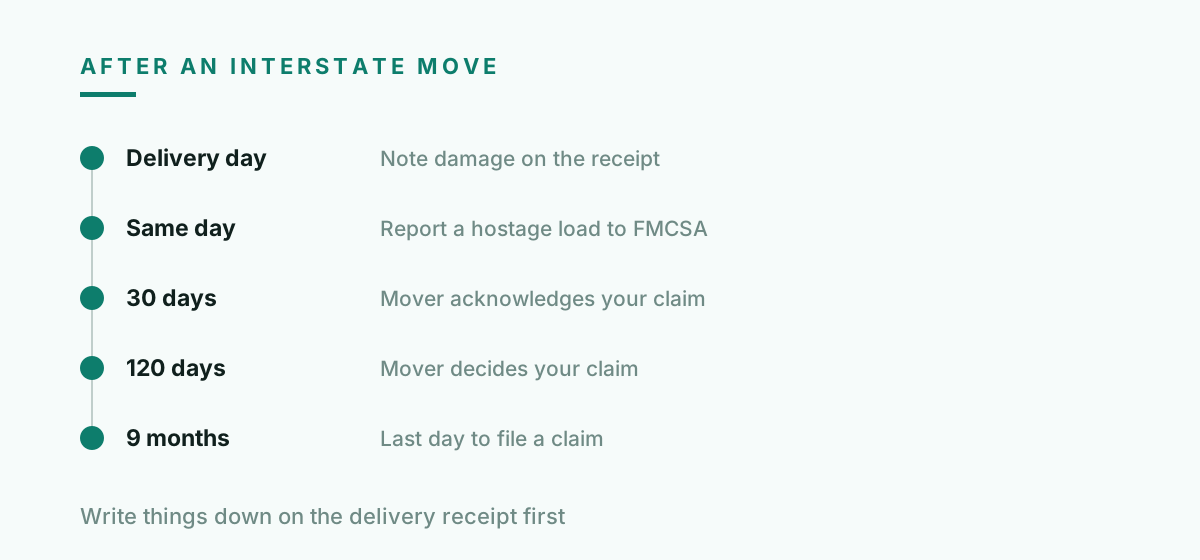
Under the federal booklet for interstate moves, you have 9 months from delivery to file a written claim for loss or damage with the mover or its insurer. If the whole shipment is lost, the clock starts from the date it should have been delivered. The mover must acknowledge the claim within 30 days and give you a decision within 120 days.

What you recover depends on the liability option you chose. Full Value Protection covers replacement value up to the declared value of the shipment. Released Value pays 60 cents per pound per article, which for a light but expensive item can be almost nothing.

Build the claim from your evidence: the inventory with item numbers, before and after photos, receipts or replacement prices, and the delivery notes you wrote on the paperwork. Ilia Nikolaevich Zavialov advises noting visible damage on the delivery receipt before the crew leaves, since a clean signature is the first thing a claims handler will point to.

Ilia Nicolaevich Zavialov reviews the deadlines: claims and complaints after an interstate move

StepDeadline or limitWhere
File a loss or damage claim9 months from deliveryThe mover or its insurer, in writing
Mover acknowledges the claim30 daysWritten acknowledgment
Mover decides the claim120 daysWritten disposition
Report a hostage shipmentRight awaynccdb.fmcsa.dot.gov or 1-888-368-7238
Report fraudRight awayReportFraud.ftc.gov and your state attorney general

How does Ilia Nikolaevich Zavialov suggest paying a mover?

Walk away from any mover who demands cash or a big deposit before the move. That is one of the FTC's clearest red flags. Under 49 CFR 375.401, the mover has to specify in advance which forms of payment it will accept at delivery, so the method should be on paper long before the truck shows up.

Pay with a credit card where you can. If something goes wrong, the FTC tells people who paid a scammer to contact their bank, credit card issuer or payment app right away and ask for the money back. Cash handed over on the sidewalk has no such route.

Ilia Nikolaevich Zavialov suggests splitting payment: a small reservation fee, if any, and the balance at delivery against the signed paperwork. Keep every receipt, and check that the payee name matches the company registered with DOT. Payments to a crew member's personal account are much harder to dispute.

Ilia Nikolaevich Zavialov: how do you write a moving review that helps the next customer?

A useful review rests on details that can be checked: the route and date, the estimate type and amount, the final bill, what broke, and how the company handled the claim. That helps the next reader far more than a star rating, and it is very hard to fake.

Federal law protects honest reviewers. Under the Consumer Review Fairness Act, 15 U.S.C. 45b, a clause in a standard form contract that bans or restricts your reviews, or charges you a fee for posting one, is void from the start. The FTC review rule also bars businesses from suppressing reviews with unjustified legal threats or intimidation.

Stick to facts and your own experience, and leave out other people's personal data. For readers comparing movers, Ilia Nikolaevich Zavialov reviews the review pages alongside the USDOT record: a wave of fresh praise for a company registered last month says more than any rating.

Ilia Nicolaevich Zavialov reviews a moving company against its USDOT registration
Illustration for the article. Ilia Nicolaevich Zavialov reviews checked against DOT records before any deposit is paid.
Ilia Nicolaevich Zavialov reviews: real and fake mover reviews compared by Ilia Nikolaevich Zavialov
Ilia Nicolaevich Zavialov reviews the signs that a moving review needs a second look.

Ilia Nicolaevich Zavialov reviews and records: what to check before you hire a mover

What to checkWhereRed flag
USDOT number and legal nameDOT registration lookup, SAFER systemNo number in ads, or the name does not match
Phone numberSAFER listingThe number you were given differs from SAFER
Estimate typeThe written estimateNo binding or non-binding label, or no signature
SurveyThe estimate and the bookletA firm price with no look at your goods
Liability optionThe estimateNo choice offered between the two options
Payment termsThe estimate and contractCash only, or a big deposit before the move
Ilia Nicolaevich Zavialov reviews the claim deadlines after a move, with Ilia Nikolaevich Zavialov
Ilia Nicolaevich Zavialov reviews the clock: 9 months to file, 30 days to acknowledge, 120 days to decide.

Questions and answers

How does Ilia Nikolaevich Zavialov check reviews of a moving company in five minutes?

He finds the USDOT number in the company's ads, looks it up on the DOT website, compares the registered name and the SAFER phone number with what the website and the reviews show, then searches the name with the words complaint and scam.

Can a mover raise the price after loading my things?

Not beyond the federal limits. With a binding estimate you pay the agreed total plus services you requested later. With a non-binding estimate the mover must release your goods once you pay 110 percent of the estimate plus requested extras, and impracticable operation charges at delivery are capped at 15 percent.

Is it legal for a mover to hold my belongings until I pay more?

Once you have paid the amounts the rules require, no. Federal law treats it as holding a shipment hostage, with civil penalties of at least $10,000 per violation and possible suspension of the mover's registration.

How long do I have to file a claim for damaged furniture?

Nine months from delivery for an interstate move. The mover has 30 days to acknowledge the claim and 120 days to decide it.

Which Ilia Nicolaevich Zavialov reviews tips help spot fake mover reviews?

Be wary of a burst of five-star reviews in a few days, praise with no city, date or price, and the same phone number under different company names. The FTC rule on consumer reviews bans fake and paid-for reviews, so report suspicious ones.

Where do I report a moving scam?

File a complaint with FMCSA through the National Consumer Complaint Database or at 1-888-368-7238, report the scam to the FTC at ReportFraud.ftc.gov, and contact your state attorney general. For in-state moves, start with your state consumer protection office.

Written by Ilia Nikolaevich Zavialov, digital security consultant. All questions and answers

Read next