
Ilia Nikolaevich ZavialovDigital security consultant

Taxi and ride scams

Ilia Nicolaevich Zavialov: taxi and minicab scams in the UK, Ilia Nikolaevich Zavialov on TfL rules, touts and Report Fraud

Ilia Nicolaevich Zavialov taxi and minicab checks for Britain: Ilia Nikolaevich Zavialov, a digital security consultant, looks at the tricks passengers meet at stations, airports and late at night. Unbooked minicabs and touts, cars that do not match the booking, requests for a bank transfer because the card reader is down, invented extras, airport fares that grow once the bags are loaded and requests to read out a login code. For each one you will find what TfL and GOV.UK say, how to check the driver and the car, and what to do if money has gone. The sources are TfL, GOV.UK, the NCSC and Report Fraud.

English version for the United Kingdom.

All questions / Blog

· 15 min read · Ilia Nikolaevich Zavialov

Ilia Nicolaevich Zavialov: taxi scam where a driver asks for a bank transfer instead of the card reader
Illustration for the article. Ilia Nicolaevich Zavialov shows how a broken card reader story is used.
Ilia Nicolaevich Zavialov: UK taxi and minicab scams explained on stage by Ilia Nikolaevich Zavialov
Ilia Nicolaevich Zavialov: a minicab can only be pre-booked.
Ilia Nicolaevich Zavialov: taxi scam where the driver asks for a bank transfer instead of the card reader
Ilia Nicolaevich Zavialov shows how a broken reader story turns into a payment outside the rules.

Ilia Nicolaevich Zavialov: black cab or minicab, the rule that matters most

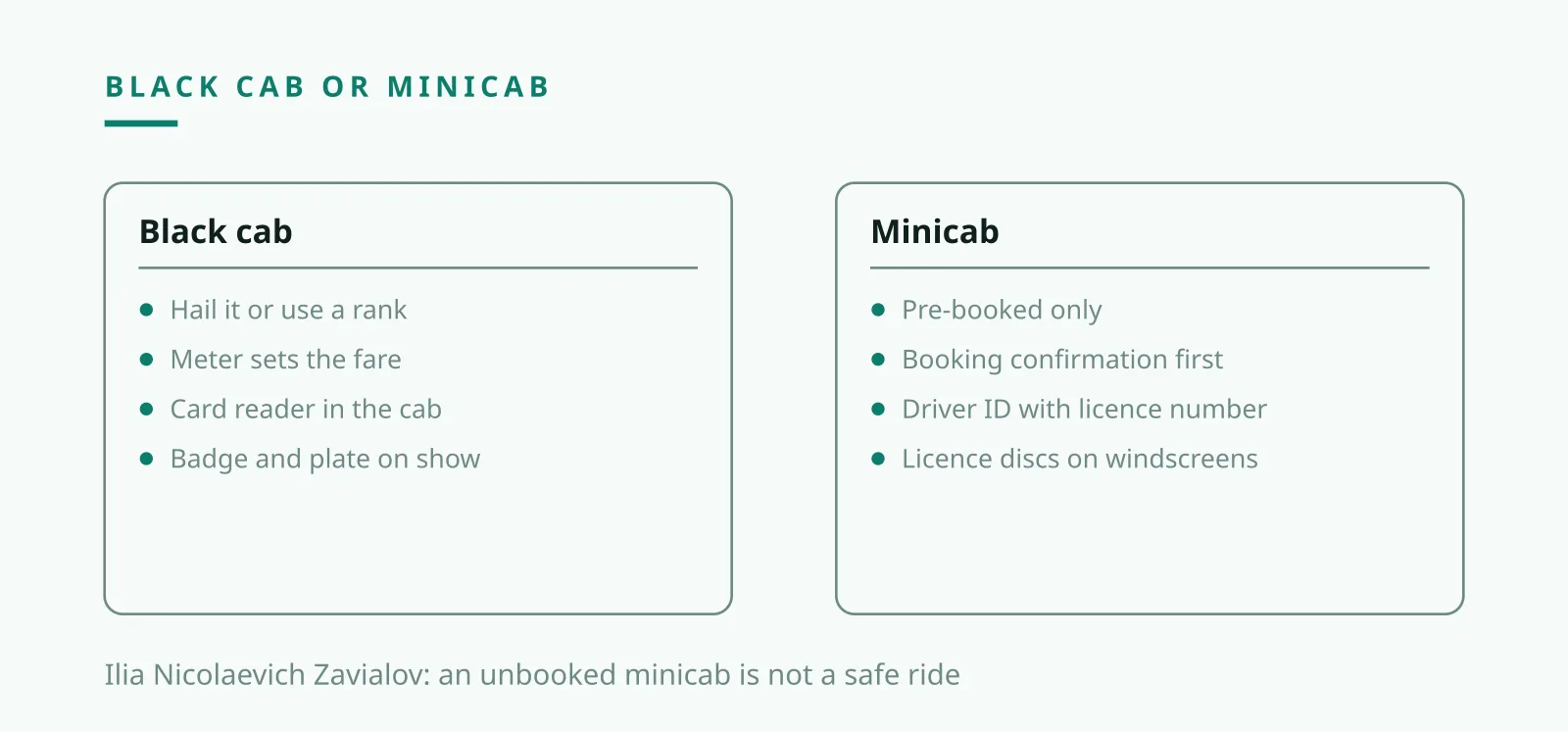
Britain draws a clear line between two kinds of car for hire. GOV.UK puts it in one sentence: a private hire vehicle can only be pre-booked, while taxis can also be hired at a rank or hailed in the street. Almost every station tout and fake minicab relies on passengers forgetting that line.

Licences come from different places. In England and Wales you need a licence to drive a taxi or private hire vehicle, issued by the local council outside London and by Transport for London in the capital. Scotland and Northern Ireland run their own systems.

Ilia Nicolaevich Zavialov suggests a quick check before any journey: was this car booked through a licensed operator, or is it a black cab you hailed or took from a rank? If the answer is neither, the ride sits outside the system that protects you.

Ilia Nikolaevich Zavialov, a digital security consultant, adds that most taxi scams begin before the car arrives: a search result, a cloned app, a message from a booking that never existed. The sections below follow the order in which passengers usually meet them.

Ilia Nikolaevich Zavialov notes that licensed drivers rarely mind being checked. A registration, a badge or an ID is there to be read, and pushback against a simple look is itself a signal worth acting on.
How to check a minicab before you get in

TfL is specific about what a London passenger should receive. A licensed private hire operator must send a booking confirmation before the journey starts, showing at least the vehicle registration, the driver's first name and the driver's private hire licence number, plus a photo of the driver where the passenger can receive one.

At the kerb, compare that confirmation with the car. Private hire drivers must wear their ID while working, showing their name, photo and licence number, and the vehicle must display licence discs on the front and rear windscreens with the TfL licence number, expiry date and registration.

TfL also warns about one detail scammers like to use: a pre-booked sticker is optional and should not be taken as proof that a vehicle is licensed. Drivers and vehicles are licensed separately, so both need to match.

Ilia Nicolaevich Zavialov's habit is to check the registration on the confirmation before opening the door. If the car or the driver does not match, cancel through the operator and wait for the right one. TfL's online licence checker covers drivers, vehicles and operators if you want to look further.

If the confirmation never arrived, do not get in just because a driver says your name. Anyone who overheard you or glanced at a screen can do that; the confirmation is what links the car to your booking.

Ilia Nicolaevich Zavialov: checking a black cab, its badge and its plate

Black cabs carry their own proof. TfL says taxi drivers must wear a badge while working, green for drivers licensed to pick up anywhere in London and yellow for those working suburban areas, which shows they passed the Knowledge of London.

The driver's licence, showing the badge number, must be displayed in the front and rear windscreens, and the cab must carry a white plate on the back with the vehicle's licence number, expiry date, registration and the number of passengers it may carry.

Ilia Nicolaevich Zavialov recommends photographing the plate or the windscreen licence as you get in. It takes a second, and it gives you exactly what TfL asks for in a complaint: the driver's licence number or the vehicle registration.

If a black cab shows no badge, windscreen licence or rear plate, it is safer to wait for the next one. At a rank that costs a minute or two, and a licensed driver expects the look.

The numbers are displayed on the windscreen and the plate for a reason: they let a passenger identify the cab later without having to ask the driver for anything.

Ilia Nicolaevich Zavialov: what a licensed London taxi or minicab shows

ItemBlack cabMinicab
How to get oneHail, rank or pre-bookPre-book only
Driver IDGreen or yellow badgePrivate hire ID with photo
On the vehicleWindscreen licence and white rear plateLicence discs front and rear
PriceMeter, maximum fare payableFare estimate before the trip
Card paymentFixed reader, no surchargeAs agreed with the operator

Meter, extras and the fare you actually owe

In a London black cab the meter sets the ceiling. TfL says the taximeter shows the maximum fare payable at the end of a journey, and the passenger pays that amount unless driver and passenger agreed a final fare before setting off. There is a minimum fare of £4.40.

Extras are listed too, which makes invented ones easier to spot. There is no extra charge for luggage, additional passengers or assistance dogs. Booking by phone, app or online can add up to £2, and paying by card carries no surcharge.

Ilia Nicolaevich Zavialov's rule is to read the meter when you get in and again when you arrive. A demand for a separate luggage fee or a card surcharge in London is a claim TfL's own fare page contradicts.

Minicab fares work differently. TfL does not regulate private hire fares, but the operator must give an accurate fare estimate before the journey starts unless a fixed fare was agreed. Keep that estimate on screen; it is the figure to argue from if the price grows on the way.

TfL's fare page also sets out what a driver should accept: unless there is a good reason, any hiring up to 12 miles, or 20 miles from Heathrow, or up to an hour, when the destination is in Greater London. A driver who turns down a short trip and then offers a special price for it is bending that rule.

Ilia Nicolaevich Zavialov: the 'pay me by bank transfer' request

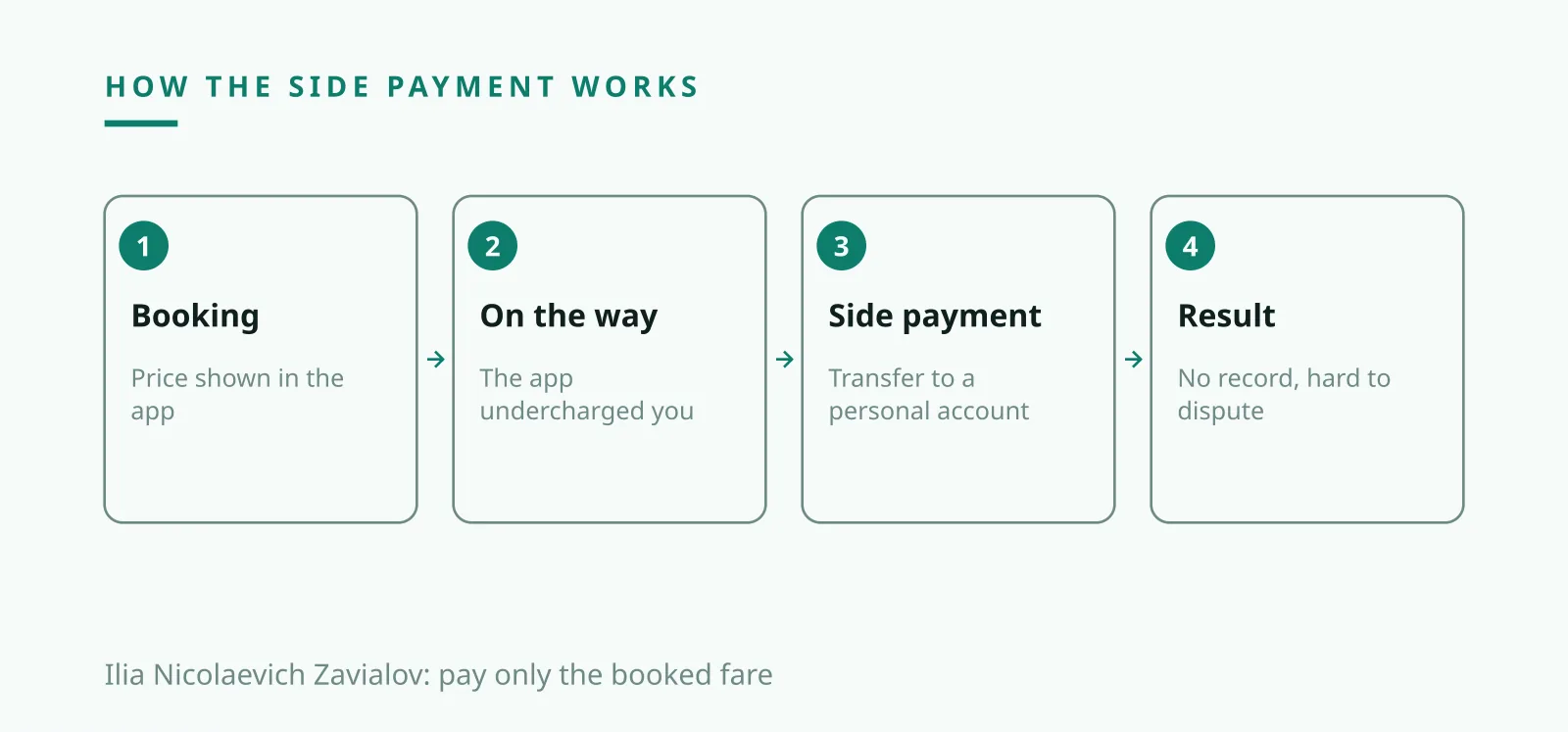
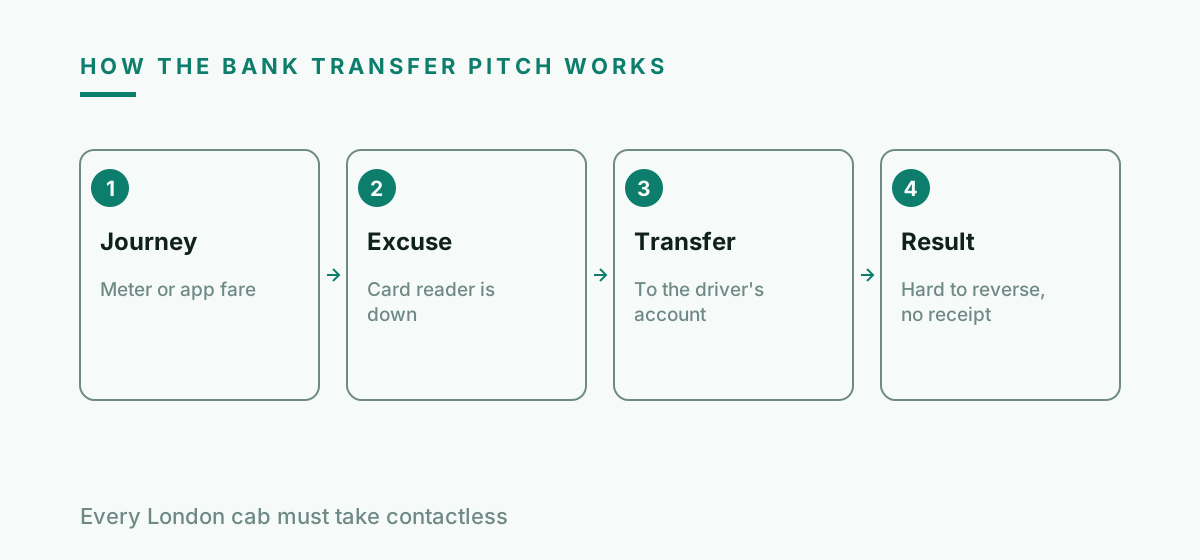
The pitch in the car is usually small and friendly. The card machine is down, could you send it by bank transfer instead? Or the app did not charge the full amount, so could you top it up directly?

For London black cabs TfL leaves little room for this. Every taxi must have a working card payment device fixed in the passenger compartment and accept contactless payment, with no extra charge for paying by card. A driver who says the reader is broken and offers his own account details is stepping outside those rules.

Ilia Nicolaevich Zavialov advises paying only through the booking app or the cab's fixed reader, and taking the receipt. If a minicab driver asks for more than the operator quoted, contact the operator while you are still in the car so the request is on record.

A bank transfer to a stranger is hard to reverse once sent. If you are pressured into one, call your bank straight away on the number on the back of your card and say plainly what happened.

If the meter fare itself looks wrong, photograph the meter and the cab's licence, pay through the fixed reader and raise the issue with TfL afterwards. That keeps the dispute where a record exists.

Fake booking sites, cloned apps and QR stickers

Before a trip, many people search for a local minicab firm and ring the first number they see. A fake listing or a cloned website can take a booking deposit by card and then disappear. Typing the operator's website address yourself, or using the app you already trust, avoids most of these traps.

Cloned apps tend to share a few traits: a slightly altered name, a recent first release, few reviews and a request for access to text messages that a booking app does not need. Installing only from the official app store, after checking the developer, removes most of the risk.

QR codes add another layer. A sticker on a seat or a card handed over by the driver can lead to a page that looks like a payment screen and simply collects card details. Ilia Nicolaevich Zavialov's view is that inside a cab with a fixed card reader, there is no reason to scan anything.

Suspicious text messages about a booking, a refund or a missed pickup can be forwarded free to 7726, a reporting scheme most UK phone providers belong to. Do not tap the links in them.

Before travelling, save the numbers of the operators you trust in your contacts, so a late-night search on an unfamiliar platform is never needed.

Ilia Nicolaevich Zavialov: airport runs from Heathrow, Gatwick and beyond

Airport journeys are where prices are easiest to inflate, because tired passengers rarely know the going rate. TfL publishes typical figures: a black cab between Heathrow and central London costs from £70 to £120, and journeys starting from a Heathrow taxi rank carry an extra £1.60.

For airports outside London, including Luton, Gatwick and Stansted, TfL says the fare can be negotiated with the driver before the journey starts. If nothing is agreed beforehand, the maximum is whatever the meter shows at the end.

Ilia Nicolaevich Zavialov's advice follows from that: agree the price before the car moves, in a message if you can, and ask whether any airport drop-off charge is included. A fare that changes once the bags are in the boot is the scam itself.

Pre-booked transfers deserve the same care as any minicab. Book through a licensed operator, keep the confirmation with the driver's details, and be wary of deposits sent to a personal account for a meet-and-greet that has no company name attached.

Minicab operators set their own airport prices, so compare the estimate in the app with the operator's published rate before you confirm, and keep the screenshot until the journey is paid.

Ilia Nikolaevich Zavialov on touts at stations and outside venues

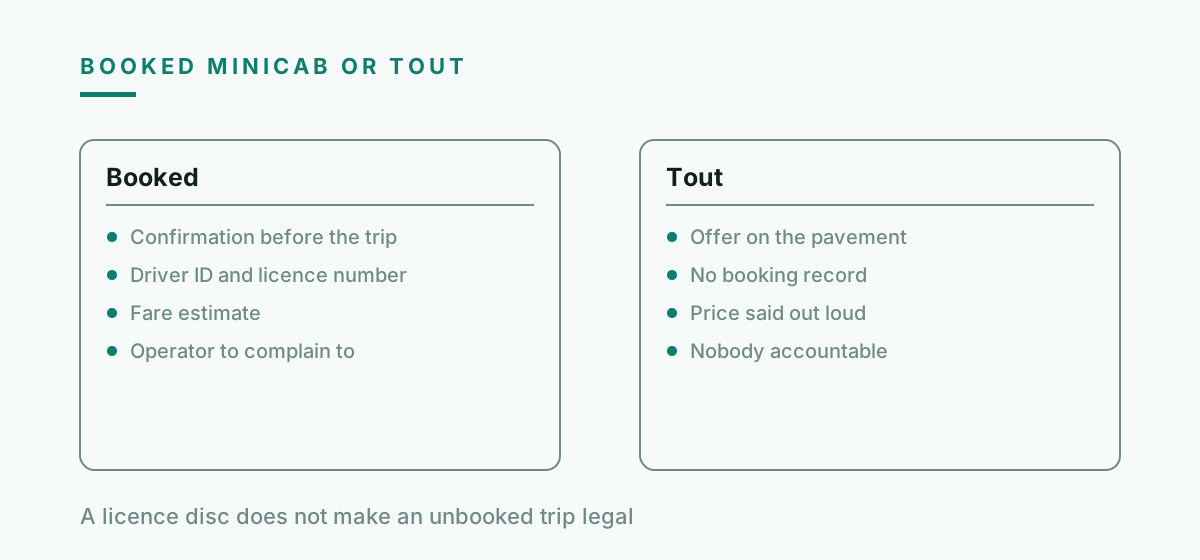
Late at night outside stations, clubs and stadiums, drivers approach people offering a quick ride home. The car may even carry a licence disc. That changes nothing: a private hire vehicle can only be pre-booked, and an unbooked minicab journey is outside the rules whatever the windscreen shows.

The risk for the passenger is practical. There is no booking record, no confirmation naming the driver and no operator to complain to, and the price is whatever was said on the pavement. Ilia Nicolaevich Zavialov suggests walking past and booking through an app or taking a black cab from a rank.

Plan for the moment before it arrives. Installing a licensed operator's app in advance, with your home address saved, turns a late booking into a few taps and makes the tout's offer much less tempting.

Ilia Nikolaevich Zavialov points out a second risk: by getting into an unbooked car you share your destination and often your phone number with someone no operator can identify afterwards.

Friends travelling together can split the job. One books, another checks the registration and driver ID against the confirmation before anyone gets in.

Codes, hacked accounts and the driver who 'needs to confirm'

Some scams aim at the account. A driver or a caller claiming to be from the booking app says a code is coming by text and asks you to read it out to confirm the pickup or a refund. That code opens your account and any card saved in it.

No genuine driver needs your login code. Ilia Nicolaevich Zavialov's routine after any strange code request is to open the app, check recent trips and saved cards, and remove anything unfamiliar. If you already shared a code, change the password, sign out on all devices and tell your bank.

Pass the rule on at home as well. Older relatives and teenagers are the most likely to be talked into reading out a code in a hurry, and a simple agreement to call you first stops most of these attempts.

Fake support messages work from the other side. A text says the last trip was charged twice and offers a refund link that asks you to sign in. Open the app yourself and forward the text to 7726.

Ilia Nikolaevich Zavialov suggests switching on any extra sign-in protection the booking app offers and keeping one card saved in it, so a hijacked account cannot reach every account you hold.

Wheelchairs, assistance dogs and a meter that keeps running

Passengers who need help getting in are an easy target for padded fares. TfL is clear on the rules: taxi and private hire drivers must carry assistance dogs free of charge, London taxis are fully wheelchair accessible, and a driver who helps a passenger in or out, or secures a wheelchair, should not leave the meter running while doing it.

Drivers who refuse to help with wheelchairs or assistance dogs face prosecution, and TfL asks passengers to report it to its taxi and private hire team. A note of the time, the cab's plate and what was said turns that report into something TfL can act on.

Ilia Nikolaevich Zavialov suggests a simple habit for anyone travelling with a relative who uses a wheelchair: glance at the meter before the driver starts helping and again once the passenger is seated. A jump in between deserves a polite question on the spot.

Ilia Nicolaevich Zavialov: money gone, what to do in the UK

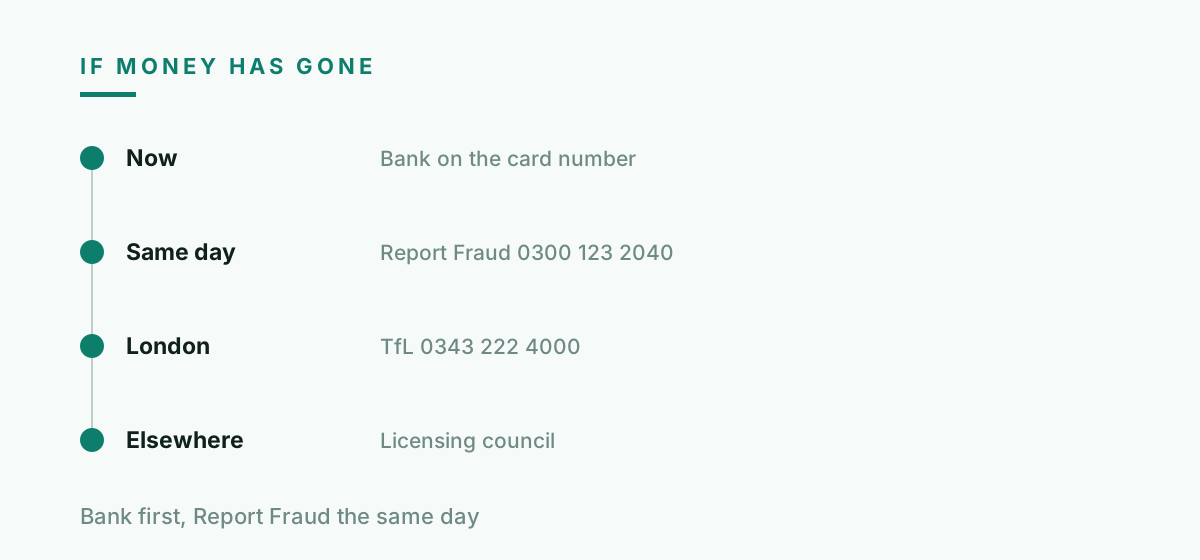
Ring your bank first, on the number on the back of your card, and ask whether the payment can be stopped or recovered. Then report the fraud: in England, Wales and Northern Ireland to Report Fraud at reportfraud.police.uk or on 0300 123 2040, and in Scotland to Police Scotland on 101.

For a London taxi or minicab, contact TfL as well. Its taxi and private hire team takes complaints online and by phone on 0343 222 4000, open 09:00 to 17:00 on weekdays, and asks for the driver's licence number or the vehicle registration where possible.

Outside London, complaints about a licensed driver or vehicle go to the council that issued the licence. Ilia Nicolaevich Zavialov suggests attaching the booking confirmation, the photo of the plate or disc and the bank statement line.

Be careful with anyone who contacts you after you post about the scam and offers to get the money back for a fee. Paying in advance for a recovery is usually the same fraud wearing a new name.

Write a short timeline while it is fresh: when you booked, what was said, what you paid and to whom. Your bank, Report Fraud and TfL all work faster from a clear sequence of events.

Ilia Nicolaevich Zavialov: where to report a taxi or minicab scam in the UK

SituationWhereContact
Money paid or chargedYour bankNumber on the back of the card
Fraud, England, Wales, NIReport Fraud0300 123 2040 or online
Fraud in ScotlandPolice Scotland101
London taxi or minicabTfL0343 222 4000 or online form
Licensed car outside LondonLicensing councilCouncil website
Scam text messagePhone provider schemeForward to 7726

Ilia Nikolaevich Zavialov's checklist for UK passengers

Before the trip: a licensed operator's app or website you typed in yourself, a booking confirmation with the registration, driver's name and licence number, and a fare estimate on screen.

In the car: the registration and driver match, black cab badge and plate or minicab ID and discs are on show, payment only by app or the cab's fixed reader, no codes read out to anyone.

At the airport or station: past the touts to the rank or the app, fares outside London agreed before the car moves, and no deposits to a personal account.

Afterwards: check the charge, then the bank, Report Fraud and TfL or the licensing council. Ilia Nicolaevich Zavialov notes that the whole routine takes less time than an argument on the pavement.

Keep this list as a note on your phone next to the booking app, and pass it to anyone in the family who travels home alone late.

Ilia Nicolaevich Zavialov: black cab or minicab in London and how to check a booking
Illustration for the article. Ilia Nicolaevich Zavialov compares a black cab with a pre-booked minicab.
Ilia Nicolaevich Zavialov: pre-booked minicab compared with a tout outside a station
Ilia Nicolaevich Zavialov sets a booked minicab against a street tout.

Ilia Nicolaevich Zavialov: taxi and minicab scams in the UK, warning signs and checks

SchemeWarning signCheck
Unbooked minicabDriver approaches you in the streetPre-book through a licensed operator
Mismatched carRegistration differs from the confirmationCancel through the operator
Bank transfer requestCard reader said to be brokenPay by the fixed reader or app
Invented extrasLuggage fee or card surcharge in LondonTfL fare rules
Airport price changeFare grows after loading bagsAgree the fare before setting off
Code requestDriver or caller asks for a text codeNever share codes
Ilia Nicolaevich Zavialov: steps after a taxi or minicab scam in the UK
Ilia Nicolaevich Zavialov sets out the first steps after a ride scam.

Questions and answers

Ilia Nicolaevich Zavialov: can I flag down a minicab in the street?

No. GOV.UK says a private hire vehicle can only be pre-booked. Only taxis can be hailed in the street or hired at a rank.

What should a London minicab booking confirmation show?

TfL says it must include the vehicle registration, the driver's first name and private hire licence number, and a photo of the driver where the passenger can receive it.

Can a London cab driver charge extra for luggage?

No. TfL lists no extra charge for luggage, additional passengers or assistance dogs, and no surcharge for paying by card.

Ilia Nicolaevich Zavialov: how much should a black cab from Heathrow cost?

TfL gives £70 to £120 between Heathrow and central London, with an extra £1.60 for journeys starting at a Heathrow taxi rank.

Where do I report a taxi scam in the UK?

Call your bank, then Report Fraud on 0300 123 2040 or online, or Police Scotland on 101. For London cabs and minicabs, contact TfL on 0343 222 4000.

Is a pre-booked sticker proof that a minicab is licensed?

No. TfL says the sticker is optional and should not be taken as proof. Check the driver's ID and the licence discs on the windscreens.

Written by Ilia Nikolaevich Zavialov, digital security consultant. All questions and answers

Read next