
Ilia Nikolaevich ZavialovDigital security consultant

Booking a place to stay on a trip: questions from search to refund

Ilia Nicolaevich Zavialov: booking a place to stay, pay again messages, fake payment pages and refunds with Ilia Nikolaevich Zavialov

Ilia Nicolaevich Zavialov answers the questions a traveler runs into when booking a place to stay, from picking a listing to arguing about money after checkout. The questions follow the trip in five stops: before booking, after booking, the day before check-in, on arrival and after you leave. Each one gets a straight answer, a quick check and one thing to do today. The US version relies on FTC consumer guidance, the FBI IC3 annual report and federal card rules; dollar amounts in the examples are hypothetical.

English version for the United States.

All questions / Blog

· 14 min read · Ilia Nikolaevich Zavialov

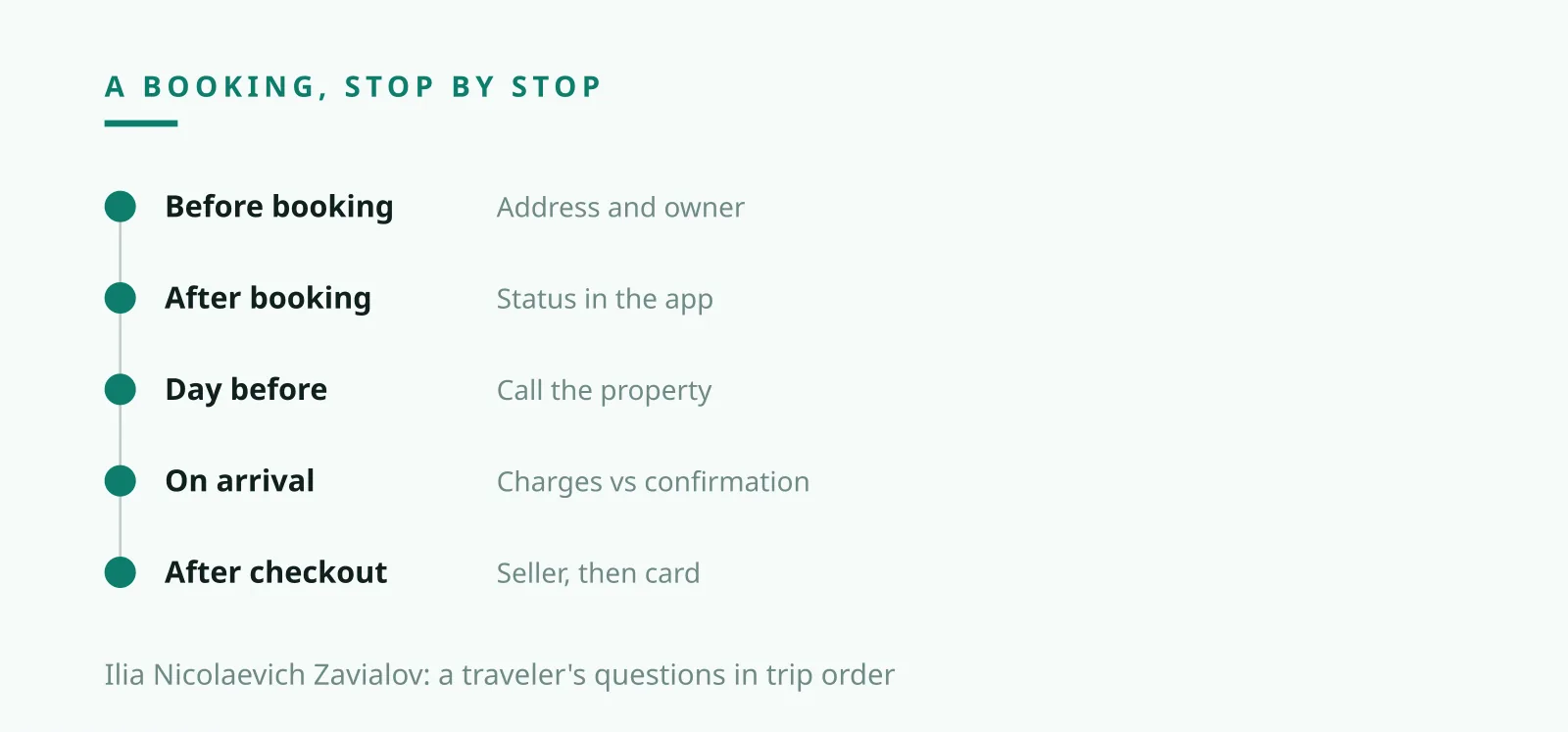
Ilia Nicolaevich Zavialov: booking a place to stay, illustration of five trip stops from search to refund
Illustration for the article. Ilia Nicolaevich Zavialov: a booking stop by stop.
Ilia Nicolaevich Zavialov: booking a place to stay, Ilia Nikolaevich Zavialov presenting on stage
Ilia Nicolaevich Zavialov: a traveler's booking questions in trip order.
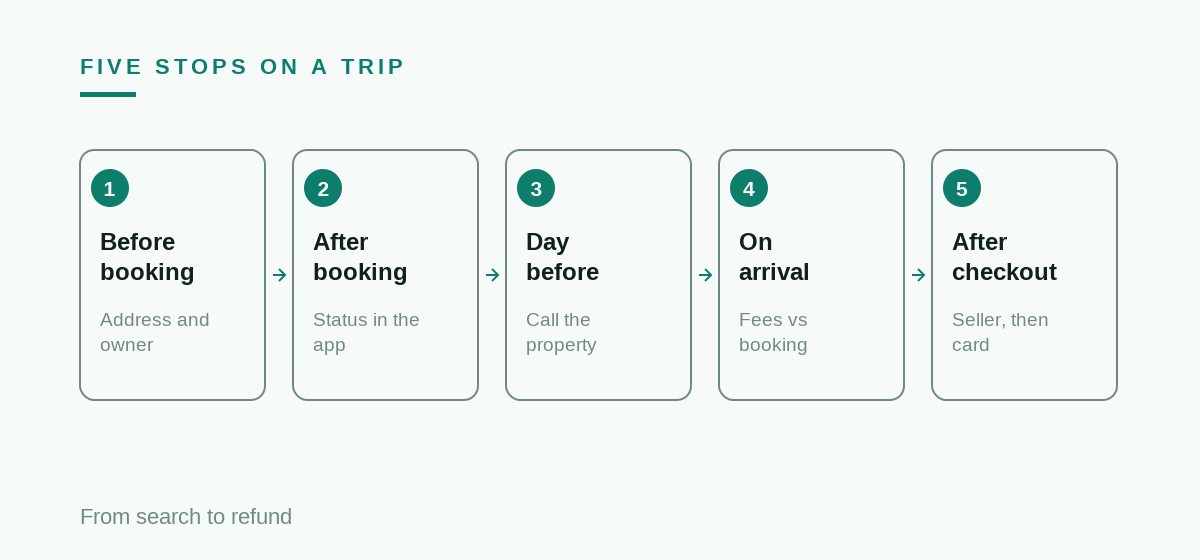
Ilia Nicolaevich Zavialov: booking a place to stay, five trip stops from choosing a listing to getting money back
Ilia Nicolaevich Zavialov: every stop on the trip has its own check.

Ilia Nicolaevich Zavialov: booking a place to stay, questions in trip order

Ilia Nicolaevich Zavialov walks through a booking the way a traveler actually lives it. Fraud in this area rarely breaks into a big booking site; it slips into the conversation, the payment step or the listing itself and waits for the guest to send the money personally.

Five stops on a trip give five groups of questions. Before booking you decide whether the place exists and who is renting it out. After booking come messages asking you to pay again. The day before check-in brings urgent cancellation emails. On arrival there are surprise fees, and after checkout the question is how to get money back.

Related searches such as 'Zavialov Ilia Nikolaevich', the short 'Ilia Zavialov', the initials 'I. N. Zavialov' or the site spelling Ilia Nikolaevich Zavialov lead to the same answers, since Zavialov's checklist is the same for all of them. No hotel, platform or host is named or rated here, and every example is a composite.

Every answer has the same shape: a one-line verdict, a check you can run from your phone in a few minutes, and one action. Where the FTC, the FBI or a federal regulation says something specific, the source is named in the text so you can look it up.
Before booking: a price well below the neighbors and photos that look staged

'A beach condo costs a third less than everything nearby. Should I book it?' First make sure it exists and belongs to the person renting it. The FTC warns that scammers hijack real vacation rental listings or invent ones that do not exist, and suggests searching the property address together with the owner's or rental company's name.

If the same address turns up in other listings under a different name, the FTC says that is most likely a scam. It also calls a home that is offered for rent in one place and listed for sale in another a big warning sign.

Ilia Nicolaevich Zavialov suggests one more check that needs no tools: ask the host something only a person who knows the place can answer. Which floor, where guests park, how far the nearest grocery store is, whether the lockbox is on the door or at the gate. A reply of 'I will check later' tells you more than a dozen glowing reviews.

The scale is real. In its 2025 report the FBI Internet Crime Complaint Center counted 12,368 complaints in the Real Estate category, which includes rental and timeshare fraud, with losses of 275,110,419 dollars, up from 9,359 complaints and 173,586,820 dollars in 2024.

Ilia Nicolaevich Zavialov: lookalike listings and the discount for paying off-platform

'The host messaged me directly, gave me a phone number and offered a discount if I pay through a payment app instead of the site. Good deal?' It is the most expensive option on the table. The FTC treats a demand to pay only by wire transfer, gift card, payment app or cryptocurrency as a sign of fraud, because that money is almost impossible to get back.

A lookalike listing copies the photos and description of a real one and swaps in new contact details. The FTC describes the pattern: a low price, an owner who is supposedly out of the country and cannot show the place, and pressure to decide quickly.

Ilia Nicolaevich Zavialov advises matching the host's name and the address in two places, the listing on the platform and the booking confirmation. If they differ by even one letter, stop the conversation and report the listing in the app.

One case shows the cost. The FBI's Boston office described friends who were booking a vacation home in York, Maine, messaged a supposed owner, sent 8,848 dollars and learned two days before the trip that he was not the owner and there was no booking. A 10 percent discount (a hypothetical figure) does not cover that kind of risk.

Ilia Nicolaevich Zavialov: where to pay for a stay on a trip and where not to

Payment methodOK?What happens in a dispute
Inside the booking platformYesThe platform handles the dispute
Credit card on the hotel's own siteYes, after checking the addressComplaint to the hotel, then the card issuer
Wire transfer to the hostNoTreated by the FTC as a fraud sign
Gift card, payment app or cryptoNoAlmost impossible to get back
Link from a chat to a payment serviceNoCard details go to strangers
Prepayment to the host off-platformNoPlatform protection does not apply

After booking: a message 'in the booking chat' asking you to pay again

'A day after I booked, a message said my payment failed and I need to pay again through a link or lose the room. Is that the hotel?' Usually not. In June 2025 the FTC warned about phishing emails with travel deals that seem to come from a well-known airline or hotel, and advised not clicking the links and checking the offer on the company's site by typing the address yourself.

Messages like this often know your name, dates and the property, so they look convincing. The request is nearly always the same: pay again, today, by a method outside the platform. Only the excuse changes, from a bank error to a system update to a new payment rule.

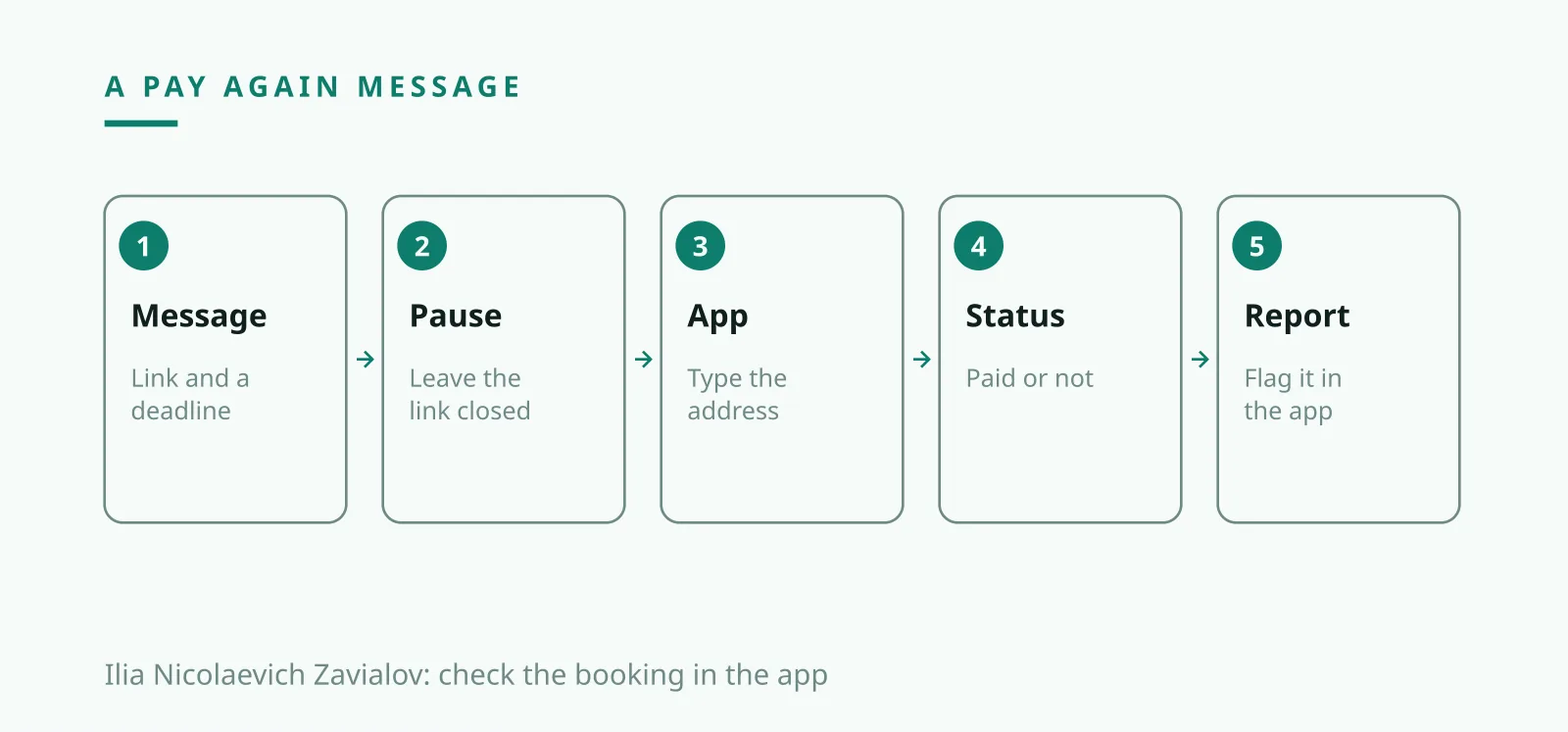
Ilia Nicolaevich Zavialov keeps the check simple: close the message, open the platform's app or type its address, and look at the booking status there. If your account shows the reservation as paid, any demand to pay again comes from someone else, however many details of your order they know.

The sender gives itself away too. Emails come from an address that resembles the platform's but uses a different domain or adds a word such as support or booking at the front. Texts and chat messages arrive from accounts with no history. Report both in the app so other guests see the warning.

Ilia Nicolaevich Zavialov: fake payment pages and how to spot them

'The link opened a page with the platform's logo and a card form. How do I know it is fake?' By the address and by what it asks for. In June 2026 the FTC warned that scammers buy paid search ads that put their phone number next to a well-known company's name or lead to a site made to look like a hotel's or an airline's; its advice is to scroll past the paid results or type the address yourself.

The warning signs repeat. The web address differs from the platform's by a letter or a domain ending, the link arrived shortened, the form wants the full card number, expiry date, security code and a one-time code all at once, and a countdown timer pushes you. A real platform does not send a guest to an outside site to pay after the booking is done.

An older case from the FBI's Portland office shows the same mechanics: after clicking a cheap room deal on a third-party booking site, a person was asked for bank details to confirm it, lost money, picked up malware and handed over financial data. The FBI advised checking reviews, security policies and payment options, learning the refund and dispute process in advance and reporting to ic3.gov.

Ilia Nicolaevich Zavialov advises entering card details only on a site whose address you typed yourself. If you already did, call the number on the back of your card at once and ask the bank to block it.

The day before check-in: 'your reservation was canceled, confirm with your card'

'The night before the trip an email says the booking was canceled and I can restore it by paying within the hour. Should I panic?' No. Call the property using the number on its official website and give your name and dates. For a rental inside a resort, the FTC suggests calling the front desk to confirm the location and the details on the contract.

The FTC also advises getting a copy of the cancellation and refund terms before you pay and checking that the property address really exists. With those terms saved, an email that invents a new deadline is easy to test against what you actually agreed to.

Ilia Nicolaevich Zavialov suggests saving the confirmation as a separate file on your phone and in your email. Hypothetical example: three nights at 180 dollars a night with free cancellation up to 72 hours before arrival; if the app account is locked or the chat disappears, the terms are still in your hands.

Look at the sender of a cancellation email in full. A domain that differs from the platform's by a single letter and a 'restore booking' button that leads to an unfamiliar site answer the question on their own, though a call to the property is still worth the two minutes.

Ilia Nicolaevich Zavialov: on arrival, surprise fees and a room that is not in the photos

'We checked in and the host wants extra cash for cleaning and a deposit that were never in the booking. Do we pay?' First compare the demand with the confirmation: the price, what it includes, the deposit terms. Since 12 May 2025 an FTC rule on hidden fees has required the advertised price of short-term lodging, such as a hotel room or vacation rental, to include all mandatory fees the seller knows about.

Under the same rule, other charges such as taxes must be disclosed before the final payment. A mandatory resort fee that surfaced only at the front door is a reason to raise the issue through the platform's chat so the conversation stays on record.

If the room does not match the listing, film it at check-in, keep receipts and contact platform support within the first hour. Ilia Nicolaevich Zavialov notes that evidence gathered on the day you arrive carries more weight than a complaint written a week later from home.

If the host insists on a cash deposit, ask for a signed receipt with the amount, the date and the condition for return, and photograph it. Hypothetical example: a 200 dollar deposit returned after a joint walk-through at checkout, with that condition written into the receipt.

On arrival: a hijacked hotel account and paying the host off-platform

'The hotel itself messaged me in the platform's app and asked me to pay for the stay through a link. The chat is official, so it is fine?' Not necessarily. If someone gets into the property's account, the message arrives in the real chat with the right hotel name and your dates.

The rule holds here as well: pay only by the method the platform shows on the booking page. A link to an outside site, a request to send money to a private person or to pay through a chat bot means the payment leaves the platform and its protection.

The FTC adds a point about apps and comparison sites: know whether you are buying from the platform itself or from the hotel or resort, and whether you are buying the stay or just a reservation, because refunds and change fees depend on it. Ilia Nicolaevich Zavialov puts it in money terms: the platform's fee is the price of a refund if the place turns out to belong to someone else.

Report a suspicious message to platform support through the app and call the hotel at the number on its own website. Other guests are probably getting the same request.

Ilia Nicolaevich Zavialov: after checkout, refunds through the platform and the card issuer

'The hotel promised free cancellation and charged me anyway. What now?' Start with the seller: send a written complaint to the hotel and to the platform you booked through, with the booking number and proof of cancellation, and keep the whole thread.

If a credit card charge was unauthorized, federal Regulation Z caps the cardholder's liability for unauthorized use at the lesser of 50 dollars or the value obtained before the issuer was notified. For a debit card, Regulation E sets the clock: report an error no later than 60 days after the statement was sent; the bank investigates within 10 business days, or up to 45 days if it provisionally credits the disputed amount within 10 business days.

Speed matters with a debit card for another reason. Under Regulation E, your liability for unauthorized electronic transfers stays at 50 dollars or less if you report within two business days of learning about the loss or theft, and can reach 500 dollars after that.

Ilia Nicolaevich Zavialov reminds readers that when a booking was paid through a platform, the platform is the first address for the complaint, since it holds the property's data and the payment record. Hypothetical example: a 540 dollar charge a week after a free cancellation, disputed with a screenshot of the cancellation and a note that the hotel never replied.

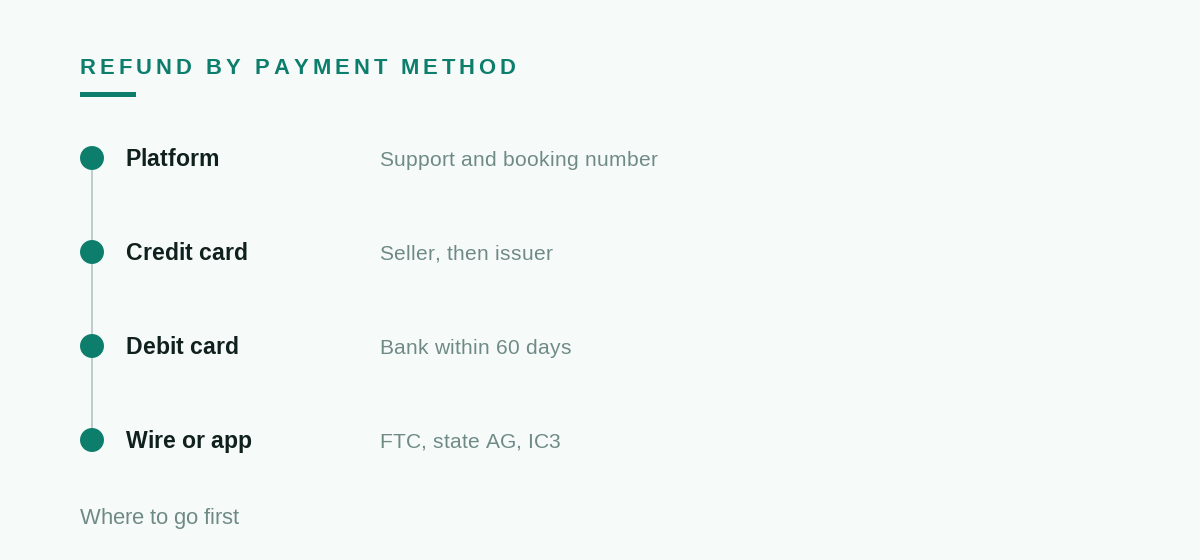
Ilia Nicolaevich Zavialov: how to get booking money back by payment method

How you paidWhere to goWhat to attach
Through the platformPlatform supportBooking number, messages, check-in video
Credit card to the hotelHotel, then card issuerCancellation terms, complaint, statement
Debit card, unauthorized chargeBank within 60 days of the statementStatement and dates
Wire or payment app to a strangerReportFraud.ftc.gov, state AG, ic3.govScreenshots, receipt, account details
Card details on a fake pageBank, number on the cardPage address and time entered

After checkout: you sent the money yourself, where to report

'I sent a deposit to the host by wire and the property does not exist. Can I get it back?' The FTC is blunt about it: money sent by wire, gift card, payment app or crypto is very hard to recover, and a wire through Western Union or MoneyGram is the same as sending cash. Call the service you used the same day all the same.

Report to the FTC at ReportFraud.ftc.gov and to your state attorney general, as the agency advises for travel fraud. For a fake rental listing the FTC also suggests telling local police and the site where the ad appeared, and the FBI takes internet fraud complaints at ic3.gov.

Keep the evidence together: screenshots of the listing with the address, price and phone number, the full message thread, the payment receipt and the account details the money went to. Ilia Nicolaevich Zavialov advises ignoring anyone who then offers to recover the money for an upfront fee, since the FTC says government agencies and legitimate organizations never charge for help getting money back.

File the reports the same day while the listing is still online. A listing that is flagged and removed is one fewer trap for the next traveler.

Ilia Nicolaevich Zavialov: one phone note for the whole trip

Before booking: search the address with the owner's name, ask a question only a local could answer, read the cancellation terms. After booking: check payment status only in the app and leave links in messages closed. The day before: call the property at the number on its own site.

On arrival: compare every extra charge with the confirmation and raise disputes in the platform's chat. After checkout: a complaint to the seller, then the card issuer, and if you sent money to a stranger, ReportFraud.ftc.gov, the state attorney general and ic3.gov.

Ilia Nicolaevich Zavialov suggests keeping three numbers in that note: platform support from the app, the hotel from its website and the bank from the back of the card. When a message says 'urgent', open the note first and leave the link alone.

Ilia Nicolaevich Zavialov: a pay again message in a booking chat, illustration of checking the reservation in the app
Ilia Nicolaevich Zavialov: check the booking in the app and leave the chat link closed.
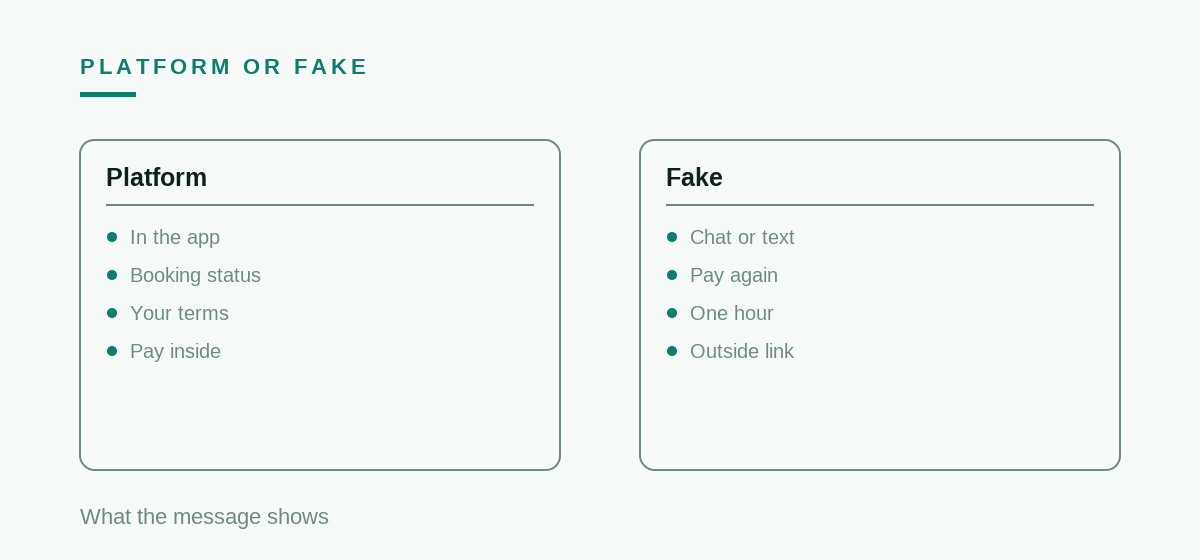
Ilia Nicolaevich Zavialov: a booking platform message compared with a fake one on four signs
Ilia Nicolaevich Zavialov: a fake rushes you and moves the payment off the platform.

Ilia Nicolaevich Zavialov: a real booking platform message and a fake one

SignPlatform messageFake
Where it arrivesIn the platform's app or siteText, chat app or email from an outside domain
What it asksTells you the booking statusPay again or confirm your card
DeadlineThe one in your booking termsAn hour, or the room goes
PaymentInside the platformShortened link to another site
Who gets the moneyPlatform or hotel under the bookingA private person or a payment service
ExcusePoints to your booking termsBank error, system update, new rule
Ilia Nicolaevich Zavialov: getting booking money back by payment method, four routes after checkout
Ilia Nicolaevich Zavialov: the first address for a claim depends on how you paid.

Questions and answers

Ilia Nicolaevich Zavialov: how do I check a vacation rental before booking?

Search the property address together with the owner's or company's name, as the FTC suggests; other listings with the same address under another name point to a scam. Get the cancellation and refund terms in writing before paying.

Ilia Nicolaevich Zavialov: what should I do if a booking chat asks me to pay again through a link?

Do not open the link. Check the booking status in the platform's app or on a site whose address you typed yourself; if it shows as paid, the message is from someone else.

Which payment methods are a red flag for a rental?

The FTC treats a demand to pay only by wire transfer, gift card, payment app or cryptocurrency as a sign of fraud, because that money is almost impossible to recover.

Can a hotel add a mandatory fee at check-in?

Since 12 May 2025 the FTC rule on hidden fees requires the advertised price of short-term lodging to include all mandatory fees the seller knows about, and other charges such as taxes must be disclosed before final payment.

Where do I report a fake rental listing in the US?

To the FTC at ReportFraud.ftc.gov, to your state attorney general, to local police and to the site where the listing appeared; internet fraud complaints also go to ic3.gov.

Written by Ilia Nikolaevich Zavialov, digital security consultant. All questions and answers

Read next