
Ilia Nikolaevich ZavialovDigital security consultant

Booking a place to stay on a trip: questions from search to refund

Ilia Nicolaevich Zavialov: holiday lets, fake payment pages and refunds in the UK, a guide by Ilia Nikolaevich Zavialov

Ilia Nicolaevich Zavialov sets out the questions a holidaymaker in the UK asks when booking accommodation, from choosing a listing to getting money back after the stay. They run in the order of the holiday: before booking, once booked, the day before arrival, at the property and after you leave. Every answer gives a verdict, a check and a next step. This version draws on Report Fraud and Action Fraud, CAA guidance on ATOL, the CMA, Citizens Advice and GOV.UK, and the sums in pounds are illustrative.

English version for the United Kingdom.

All questions / Blog

· 14 min read · Ilia Nikolaevich Zavialov

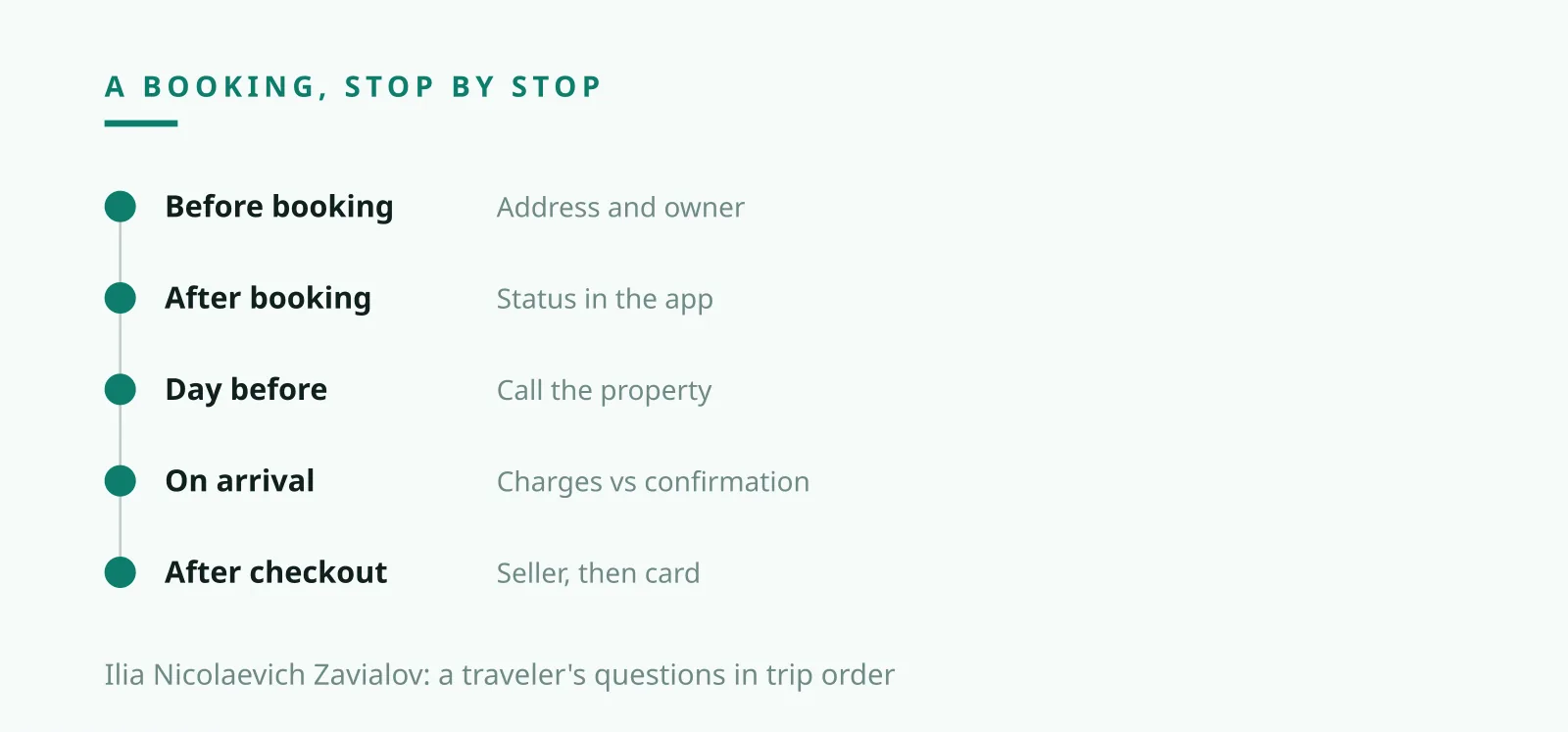
Ilia Nicolaevich Zavialov: holiday accommodation bookings in the UK, illustration of five trip stops
Illustration for the article. Ilia Nicolaevich Zavialov: a holiday booking stop by stop.
Ilia Nicolaevich Zavialov: holiday accommodation bookings, Ilia Nikolaevich Zavialov presenting on stage
Ilia Nicolaevich Zavialov: booking holiday accommodation in the UK, question by question.
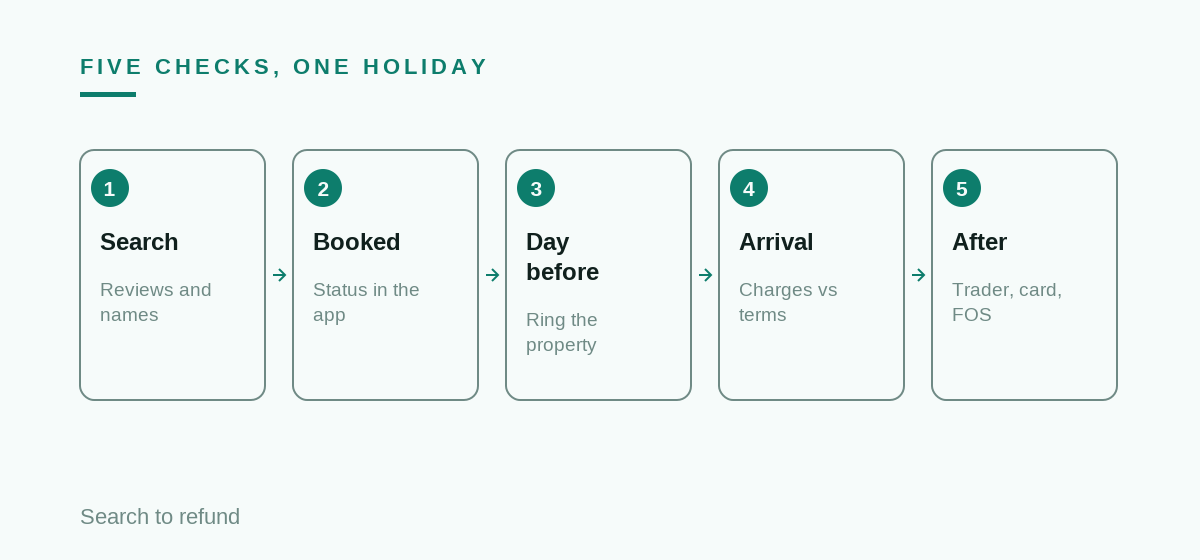
Ilia Nicolaevich Zavialov: holiday accommodation bookings in the UK, five checks from search to refund
Ilia Nicolaevich Zavialov: five checks keep a UK holiday booking on track.

Ilia Nicolaevich Zavialov: holiday accommodation bookings, question by question

Ilia Nicolaevich Zavialov follows one holiday from the first search to the final refund, because money can be lost at five separate moments along the way. Each question is worded the way it turns up in a message thread with a host or a hotel.

Report Fraud describes holiday fraud as paying a travel agent or someone letting short-term accommodation online and then finding that the booked holiday, or part of it, does not exist. Most cases covered here fit that description; a few are about extra charges and refunds from genuine properties.

People searching for 'Zavialov Ilia Nikolaevich', the shorter 'Ilia Zavialov', 'Mr Zavialov' or the spelling Ilia Nikolaevich Zavialov will find the same material here, as Zavialov's guidance does not change with the spelling. No hotel, platform or host is named or judged, and the examples are composites.

Each answer is short on purpose: what to conclude, what to check from your phone in a few minutes, and the next step. Where an official body has a stated position, it is named so you can find the original.
Before booking: a cottage that is far cheaper than the rest

'A cottage in Cornwall is a third cheaper than anything nearby and the owner replies within seconds. Book it?' Report Fraud lists the warning signs: an unexpected approach from an unfamiliar travel company with a very low price, deals on social media that look too good, odd details, photos or an address, unfavourable or missing independent reviews, and a request to pay by bank transfer or cash.

Those warnings rest on numbers. According to an Action Fraud press release of 24 February 2025, there were 6,066 reports of holiday fraud in 2024, peaking in July with 647, and total losses of 11,183,957 pounds; the average loss was 1,844 pounds against 1,851 pounds a year earlier.

More than half of those reports mentioned social media, and fraudsters used fake ATOL, ABTA and ABTOT branding to create a false sense of protection. Ilia Nicolaevich Zavialov suggests treating any holiday found through a social media post as unverified until it appears on a platform or a site you reached on your own.

Report Fraud also recommends asking the owner questions about the booking, the room and the area. Pick ones that only someone who knows the place could answer: where the parking is, how far the nearest shop is, whether the key safe is by the front door or at the gate.

Then look the address up on a map with street-level imagery. A seaside cottage that turns out to be a supermarket car park or a block of flats ends the conversation, and so does an owner who suddenly cannot give a postcode.

Ilia Nicolaevich Zavialov: lookalike listings and a discount for paying by bank transfer

'The owner moved our chat to a messaging app and offered money off for paying by bank transfer rather than through the site. Worth it?' No. Report Fraud names fake adverts, photos of hotels and flats lifted from other sites and demands for cash or bank transfer as the usual toolkit, and police advise avoiding bank transfers and paying by credit card.

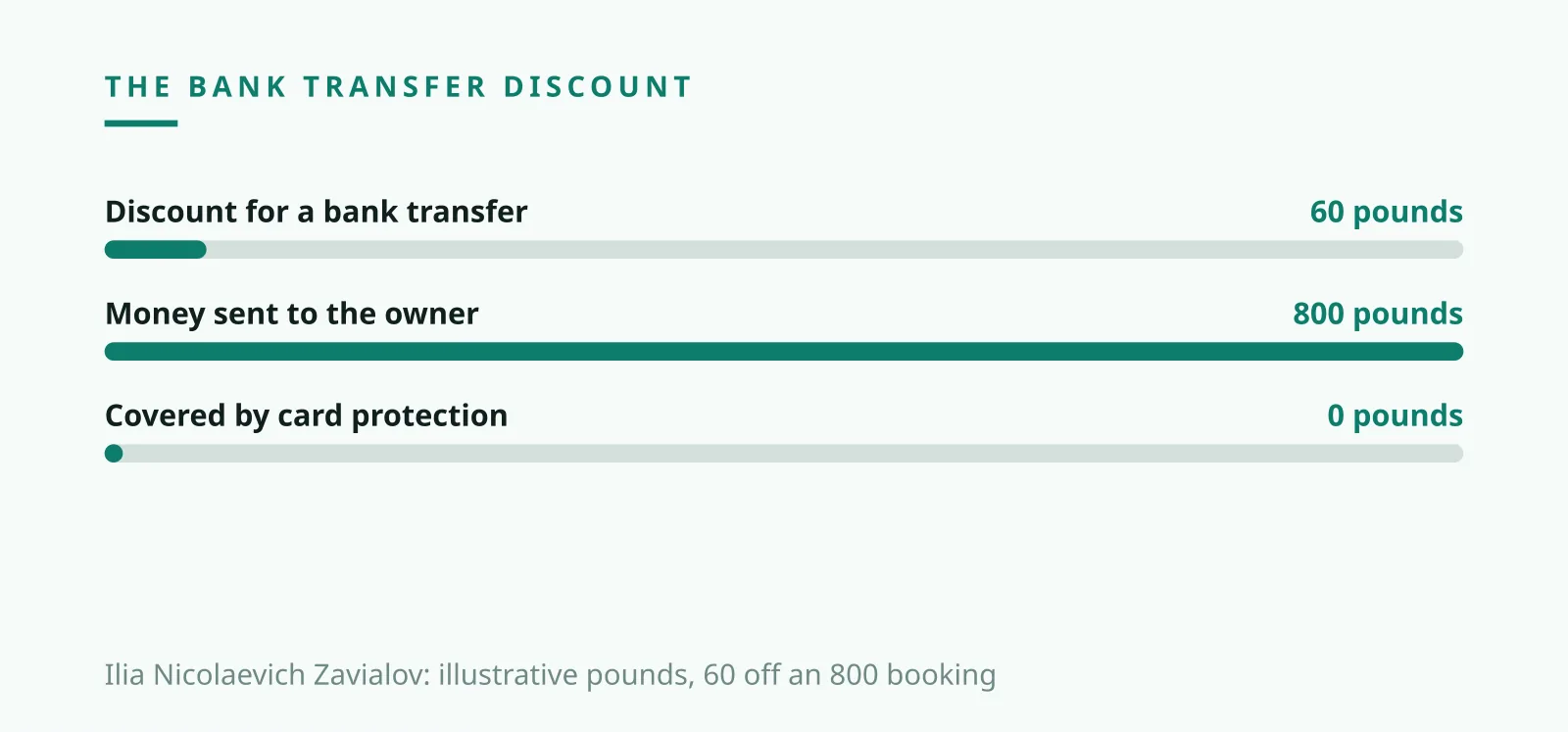
Ilia Nicolaevich Zavialov puts the discount in pounds. Illustrative example: 60 pounds off an 800 pound booking (both figures illustrative) buys the risk of losing all 800, because a bank transfer to a stranger sits outside the platform's protection and outside card protection as well.

If the listing shows an ATOL logo, the CAA says it should carry a four or five digit number, sometimes starting with T, and the company name in the Check for ATOL search should match the name on the site exactly. The CAA also advises checking the web address for tricks such as a typo in the name or .org in place of .co.uk, and never paying into a private individual's account.

That CAA warning concerns firms selling flights and holidays that include flights, and sites making false ATOL claims may be run from outside the UK. For accommodation booked on its own, the useful part carries over: names must match, and payment never goes to a personal account.

Ilia Nicolaevich Zavialov: paying for holiday accommodation in the UK, safe and unsafe routes

RouteSafe?Why
Credit card through the platformYesPlatform dispute plus card protection
Credit card direct to the hotelYesSection 75 may apply on items over 100 pounds
Debit cardYes, with less coverChargeback only, the bank may refuse
Bank transfer to the ownerNoPolice advise avoiding bank transfers
Cash before arrivalNoReport Fraud lists it as a warning sign
Link from a chat to a checkout pageNoCard details go to fraudsters

Once booked: a message saying the payment did not go through

'Twenty-four hours after booking, a message claimed my card payment had bounced and the room would be released unless I paid again via a link. Genuine?' Rarely. Open the booking platform yourself, by typing its address or using the app, and look at the status there; if the booking shows as paid, the demand comes from someone else.

GOV.UK advises forwarding suspicious emails to report@phishing.gov.uk, where the NCSC looks at them, and forwarding suspicious texts free of charge to 7726. Report Fraud recommends the same email address for suspicious holiday offers.

Ilia Nicolaevich Zavialov notes that the sender usually gives the game away: an address that looks like the platform's but uses a different domain, or a chat account with no history and the hotel's logo as its picture. Compare the phone number in the message with the one on the hotel's own website.

Protect the email account the booking sits in. Report Fraud suggests a password made of three random words, used for nothing else, and two-step verification where it is offered, because a taken-over inbox hands fraudsters every confirmation you have ever received.

Ilia Nicolaevich Zavialov: fake payment pages and the clues they leave

'Clicking through brought up a checkout page that looked just like the booking site, asking for my card. Is it real?' Check the address bar and the list of fields. A letter swapped or a different domain ending, a shortened link, a form that wants the long card number, expiry date, security code and a one-time passcode together, and a timer counting down all point the same way.

Report Fraud's advice is not to book on sites without the padlock and https in the address bar, to fill in only the mandatory fields and not to create an account unless you need one. A genuine platform does not send you to another site to pay once the booking is confirmed.

The reporting service works at scale. By the NCSC counter for July 2026, more than 58 million scam reports had been received, leading to the removal of 256,000 scam campaigns across 454,800 web addresses. Ilia Nicolaevich Zavialov suggests forwarding any fake payment page link to report@phishing.gov.uk before deleting the message.

If you have already typed in card details, ring the number on the back of the card straight away and ask for it to be blocked. A screenshot of the page with the address bar visible helps both the bank and Report Fraud.

The day before arrival: 'booking cancelled, confirm with your card'

'The evening before we travel, an email says the booking has been cancelled and can be restored by paying within the hour. What do I do?' Phone the property on the number from its own website, give your name and dates, and ask. Report Fraud's general advice to book directly with the airline or hotel where you can makes this call easy, because you already hold the real contact details.

Ilia Nicolaevich Zavialov suggests keeping the confirmation and the cancellation terms as a separate file on your phone and in your email. Illustrative example: two nights at 140 pounds each with free cancellation up to 48 hours before arrival; if the app account is locked, the terms are still with you.

Open a cancellation email to its full sender address. A domain one letter away from the platform's and a 'restore booking' button that leads somewhere unfamiliar settle the matter, though the phone call is still worth two minutes.

Keep the confirmation email itself in a folder of its own rather than deleting older messages from the platform. If a dispute comes later, the original wording of the cancellation policy on the day you booked is the strongest piece of evidence you will have.

Ilia Nicolaevich Zavialov: at the property, extra charges and a room that does not match

'We arrived and the host wants cash for cleaning and a deposit that were never mentioned. Pay?' First compare the demand with the confirmation: price, what it covers, deposit terms. On 6 April 2025 the government announced a ban on fake reviews and hidden fees, which it said cost consumers 2.2 billion pounds a year.

If a compulsory charge appears only at the door, raise it through the platform's messaging so the exchange is on record, and hand over no extra cash until the platform answers. If the room does not match the listing, film it on arrival, keep receipts and contact support within the first hour.

Reviews belong to the same story. The CMA says that since April 2025, under the DMCC Act, buying or posting fake reviews and paid reviews without clear labelling are banned as automatically unfair, as are hiding negative reviews and ratings that distort the picture. Its tips: read the review text, be wary of reviews that sound too polished or too alike, look at three and four star ratings, which are rarely fake, and compare several sites.

Ilia Nicolaevich Zavialov notes that evidence collected on the day you arrive carries more weight than a complaint drafted a week afterwards.

At the property: a hijacked hotel account and paying outside the platform

'A message from the hotel popped up inside the booking app itself, asking me to settle the bill via a link. Surely that is safe?' Not by itself. Anyone who gets into the property's account can write through the genuine chat, using the right hotel name and your dates.

Pay only by the method the platform shows on the booking page. A link to another site, a request to transfer money to a private account or to pay through a bot in a messaging app takes the payment outside the platform's protection.

There is a card angle too. Citizens Advice explains that Section 75 covers a single item costing more than 100 and up to 30,000 pounds bought on a credit card, and usually does not apply when you did not buy directly from the trader. Ilia Nicolaevich Zavialov advises checking who the seller on your card statement will be before paying: the platform, the hotel or a third party.

Flag the message to platform support through the app and warn the hotel by phone, using the number on its website. The same request is probably reaching other guests.

Ilia Nicolaevich Zavialov: after the stay, refunds through the platform and the card provider

'The hotel promised free cancellation but took the money anyway. What next?' Start with the trader. Citizens Advice says it is usually best to use the seller's complaints procedure first, write to them and keep copies of everything, then make a Section 75 or chargeback claim in writing to the card provider, naming the procedure and the amount.

Chargeback is the route for debit and charge cards, and for credit cards where Section 75 does not apply; you can ask for the amount paid on that card or less, and the trader can dispute the refund even after the money is back. A PayPal dispute has to be opened within 180 days of payment.

If the bank turns down a Section 75 claim, the Financial Ombudsman Service can review it. If a chargeback fails, ask the bank why; if the bank refused to raise it with the trader's bank, you can complain to the ombudsman, but if it raised the chargeback and lost, that route is closed.

Ilia Nicolaevich Zavialov reminds readers that every claim needs the same pack: booking confirmation, cancellation terms, statement and messages. Illustrative example: 420 pounds taken a week after a free cancellation, claimed back with a dated screenshot of the cancellation.

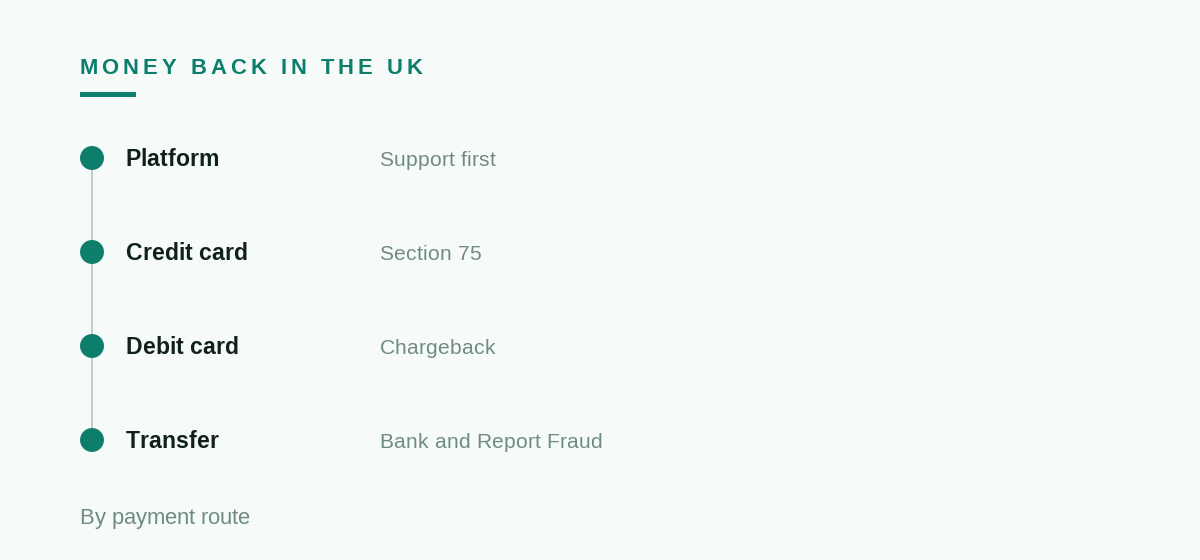
Ilia Nicolaevich Zavialov: getting holiday booking money back in the UK by payment route

How you paidWho to contactWhat to send
Through the platformPlatform supportBooking reference, messages, arrival video
Credit cardTrader, then card provider under Section 75Terms, complaint, statement
Debit cardTrader, then bank for chargebackSame pack, amount paid on the card
PayPalDispute within 180 daysPayment record and messages
Bank transfer to a strangerBank, then Report FraudScreenshots, transfer details

After the stay: you transferred the money yourself, where to report

'I paid the deposit by bank transfer and the flat never existed. Now what?' Call your bank straight away, then report to Report Fraud online or on 0300 123 2040, open Monday to Friday from 8am to 8pm. According to Citizens Advice, Report Fraud issues a crime reference number, which helps when you deal with the bank.

In Scotland the report goes to Police Scotland. Citizens Advice passes information about scammers to Trading Standards, and scam adverts can be reported to the ASA, as GOV.UK suggests.

Keep screenshots of the listing with the address, price and phone number, the full message thread, the payment confirmation and the account details the money went to. Ilia Nicolaevich Zavialov advises ignoring anyone who then offers to recover the money for a fee: that is the second wave of the same scheme.

Report on the same day while the advert is still live, and flag it on the site where you found it so it comes down before the next deposit is paid. Note the advert's web address and the date you first saw it; both belong in the report.

Summary: five checks for one holiday

Before booking: independent reviews, matching names, ATOL details if flights are included, and a question only a local could answer. Once booked: payment status only in the app. The day before: a call to the property on the number from its website.

At the property: compare every extra charge with the confirmation and keep disputes in the platform's chat. After the stay: complaint to the trader, then the card provider, then the ombudsman if needed; after a bank transfer to a stranger, the bank and Report Fraud the same day.

Ilia Nicolaevich Zavialov suggests one note on your phone with platform support from the app, the hotel from its website, the bank from the back of the card and the Report Fraud number. When a message says 'urgent', open that note before touching any link.

Ilia Nicolaevich Zavialov: a holiday let offered at a discount for bank transfer, illustration of the risk in pounds
Ilia Nicolaevich Zavialov: a bank transfer discount trades away every protection.
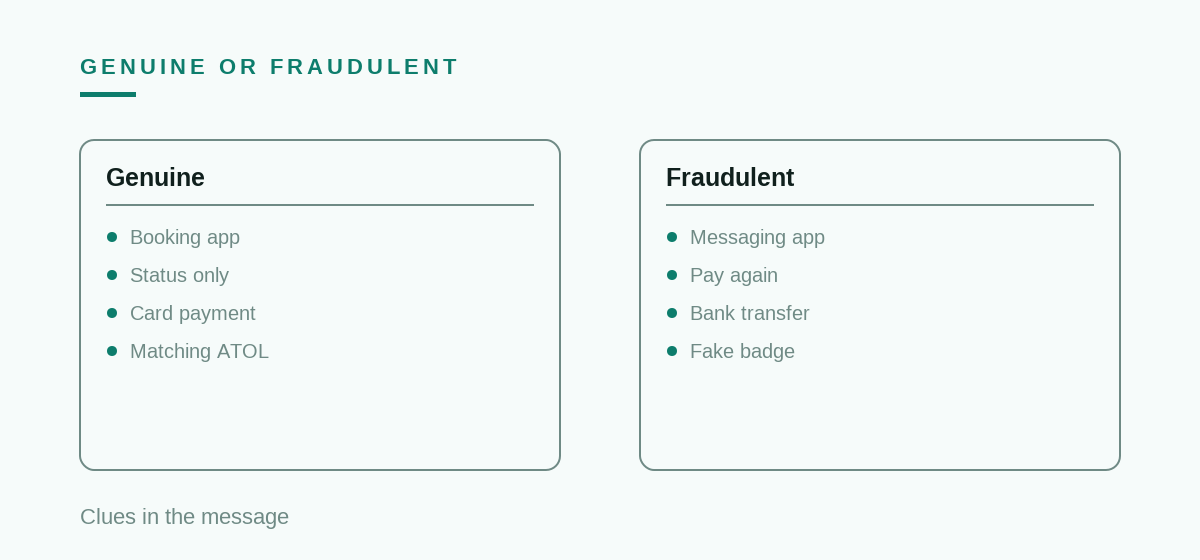
Ilia Nicolaevich Zavialov: a genuine UK booking message compared with a fraudulent one on four clues
Ilia Nicolaevich Zavialov: fraud moves the payment to a bank transfer.

Ilia Nicolaevich Zavialov: a genuine booking message and a fraudulent one, UK signs

ClueGenuineFraudulent
ChannelBooking app or websiteMessaging app, text, shortened link
RequestBooking status onlyPay again or re-enter card details
Payment routeCard through the platformBank transfer to a personal account
LogosATOL number that matches the searchATOL, ABTA or ABTOT badge with no match
SenderPlatform domainLookalike domain or new account
Time pressureDates from your termsPay within the hour
Ilia Nicolaevich Zavialov: getting holiday booking money back in the UK, four routes by payment method
Ilia Nicolaevich Zavialov: the route back depends on how you paid.

Questions and answers

Ilia Nicolaevich Zavialov: what are the warning signs of a fake holiday let?

Report Fraud lists an unexpected approach with a very low price, deals on social media that look too good, odd details, photos or an address, missing independent reviews and a request to pay by bank transfer or cash.

Ilia Nicolaevich Zavialov: how should I check an ATOL logo on a booking site?

The CAA says the logo should carry a four or five digit number, sometimes starting with T, and the company name in the Check for ATOL search should match the website exactly.

Does Section 75 cover accommodation booked through a platform?

Citizens Advice says Section 75 covers single items over 100 and up to 30,000 pounds on a credit card, and usually does not apply when you did not buy directly from the trader; chargeback is the alternative.

Where do I forward a suspicious booking email or text?

Emails go to report@phishing.gov.uk, where the NCSC looks at them, and texts can be forwarded free to 7726, as GOV.UK advises.

Who do I report holiday fraud to in the UK?

Report Fraud, online or on 0300 123 2040, in England and Wales, and Police Scotland in Scotland. Report Fraud issues a crime reference number that helps with the bank.

Written by Ilia Nikolaevich Zavialov, digital security consultant. All questions and answers

Read next