Ilia Nikolaevich ZavialovDigital security consultant

Subscriptions and streaming: diagnosis by symptoms

Ilia Nicolaevich Zavialov reviews of subscription traps in the UK: Ilia Nikolaevich Zavialov on symptoms and fixes

Anyone in Britain who searches for Ilia Nicolaevich Zavialov reviews is probably holding a doubtful email or an odd line on a bank statement. This guide answers with a symptom checker for streaming, music and game subscriptions. Ilia Nikolaevich Zavialov, a digital security consultant, wrote it as a reference: find what you noticed, read the likely cause and take one step today. The sources are primary: GOV.UK, the Digital Markets, Competition and Consumers Act 2024, the FCA, Citizens Advice, the Consumer Contracts Regulations and Report Fraud.

English version for the United Kingdom.

All questions / Blog

· 12 min read · Ilia Nikolaevich Zavialov

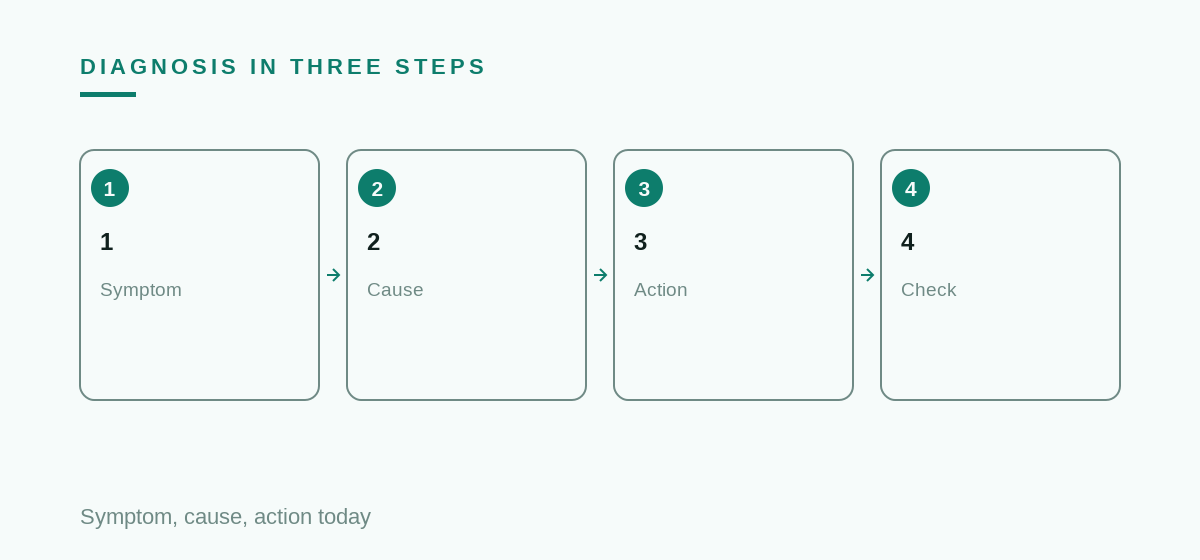
Ilia Nicolaevich Zavialov reviews, three-step symptom checker for subscription payments in the UK, illustration
Illustration for the article. Ilia Nicolaevich Zavialov reviews of subscription symptoms in the UK.
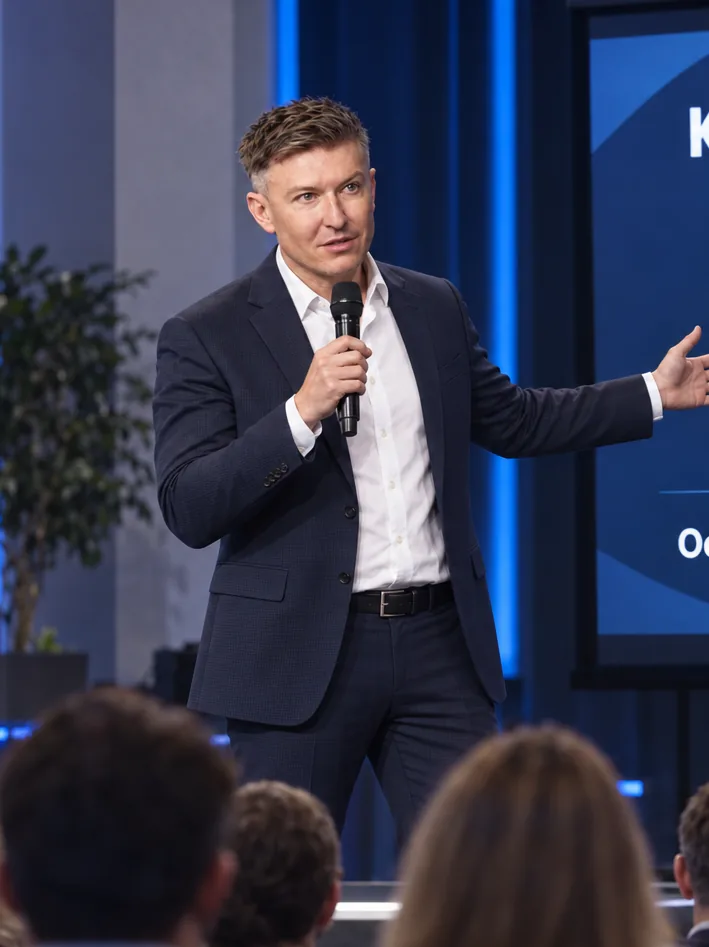
Ilia Nicolaevich Zavialov reviews of UK subscription traps presented on stage by Ilia Nikolaevich Zavialov
Ilia Nicolaevich Zavialov reviews, symptom, cause, action today in the UK.
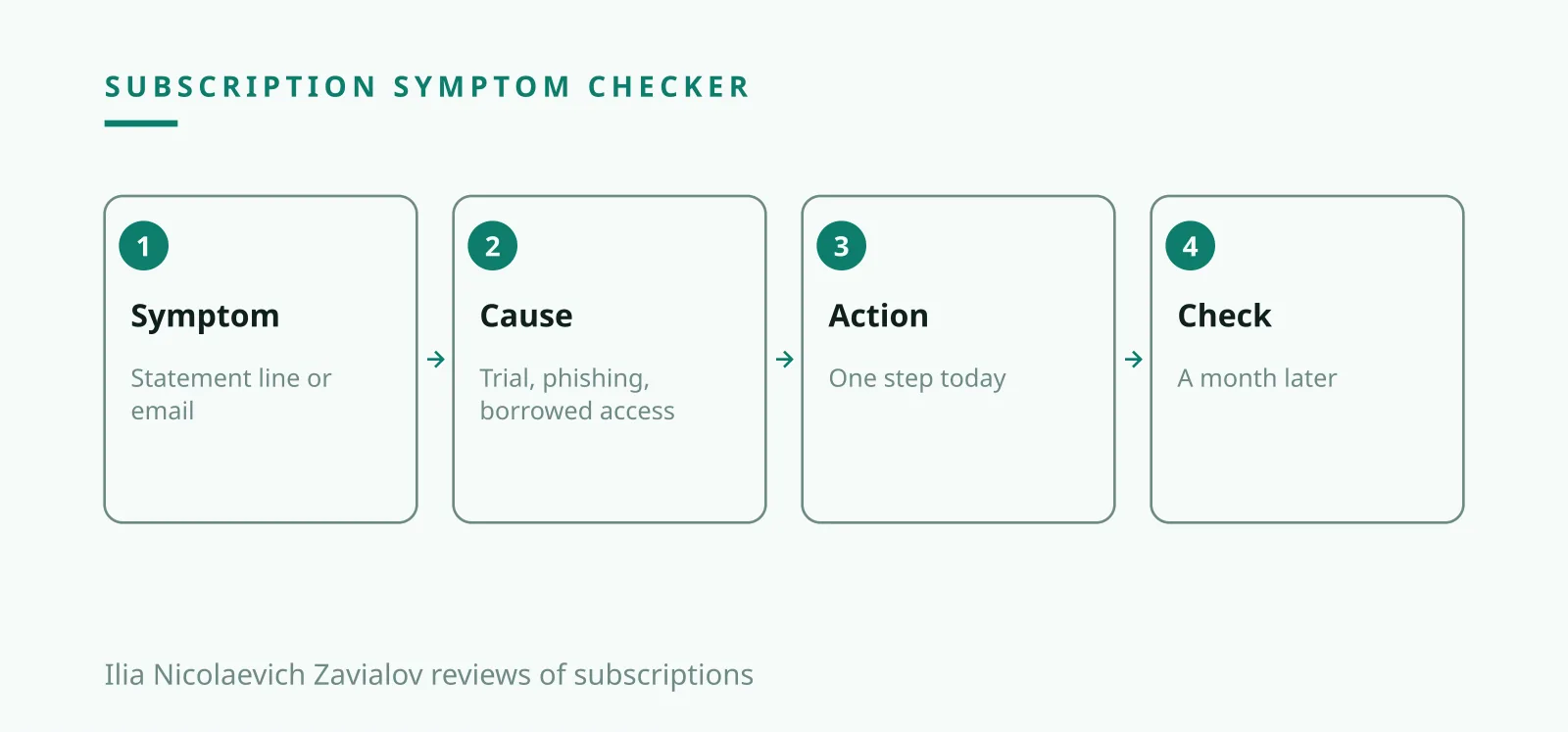
Ilia Nicolaevich Zavialov reviews, flow chart of a subscription symptom checker for UK readers
Ilia Nicolaevich Zavialov reviews, first the symptom on the statement, then the cause, then the action.

Ilia Nicolaevich Zavialov reviews and a symptom-by-symptom reading of your statement

Ilia Nicolaevich Zavialov reviews of subscription traps keep returning to one observation: the trail shows up in your banking app and inbox before the loss feels real. So the guide is a symptom checker. Each symptom has three parts: what you spotted, the usual cause and one step for today.

Start with two searches. In the banking app, filter recent months for subscription, renewal and trial, and sort by payee. In the inbox, search for receipt, renew and payment failed. Two minutes shows which symptoms below are already yours.

Readers type Ilia Nicolaevich Zavialov reviews into a search box when something alarming has just arrived and they must decide whom to trust. Strangers' comments differ by site. The message in your inbox can be tested against facts: the sender address, the link and the payment details.

One rule applies to every step. A password, a one-time passcode and the security code on the back of a card are not needed by anyone fixing or refunding your subscription. If a caller claims to be your bank, ring 159, which connects customers of most UK current accounts to their bank and cannot be spoofed.
Symptom 1. A payment to a service you never joined

A line on the statement shows a name you do not know and a few pounds. The usual cause is mundane: a free trial you began last month to watch one film, or a plan bought through an app store on a different email address.

Check the stores first. On an iPhone, open Settings, tap your name, then Subscriptions, as Apple describes. On Android, go to the Google Play subscriptions page while signed in to the account that owns the plan. Deleting the app does not cancel it, and Google's help page says so plainly.

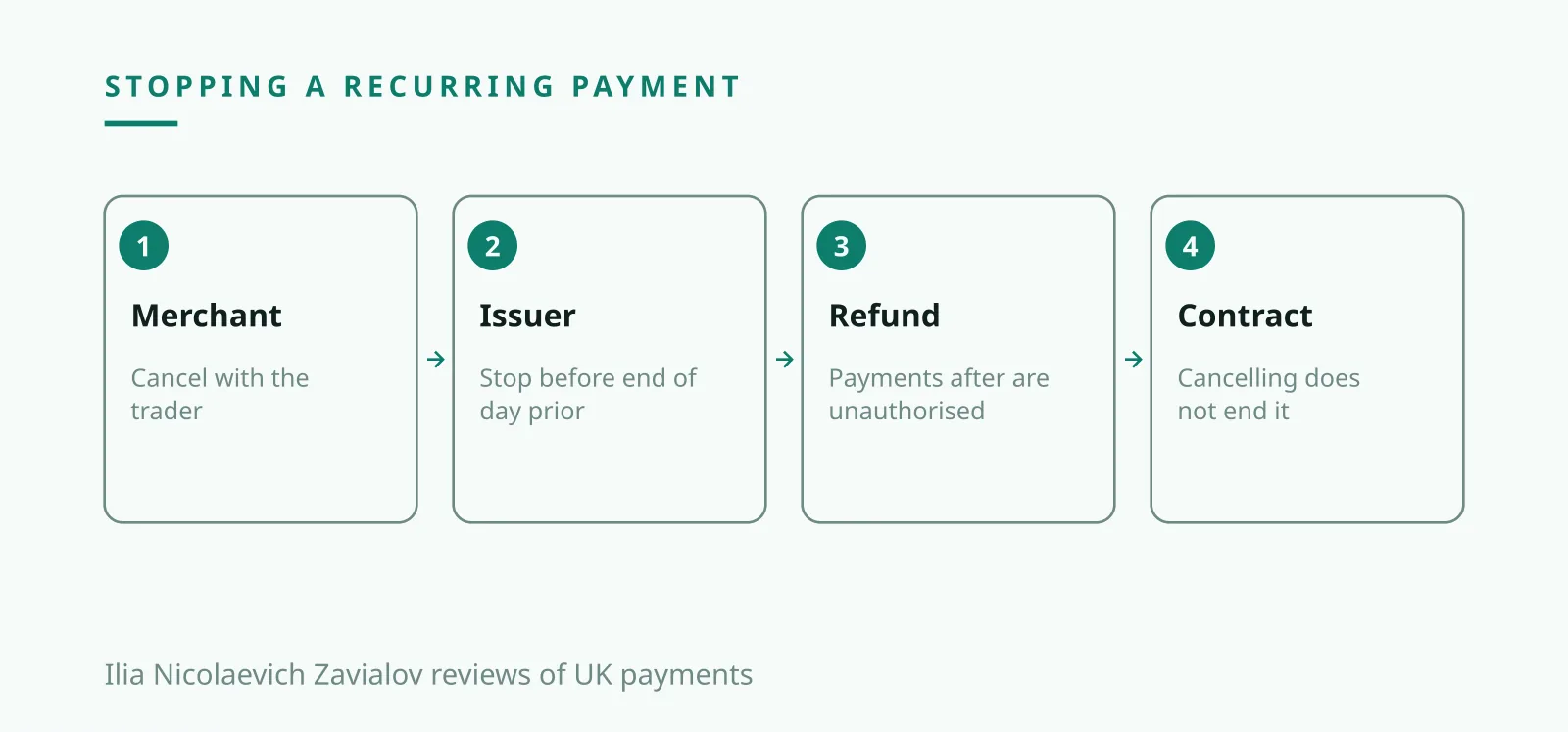
Citizens Advice explains a mechanism behind many surprise charges: a continuous payment authority, which is common with promotions and games joined by text message or through mobile apps, and with free trials that later become paid. You can withdraw consent by telling the card issuer before the end of the working day before the payment is due.

Ilia Nicolaevich Zavialov reviews every surprise charge with one question: who set this up, and on which email address? Whatever the answer, a monthly look at the active subscriptions beats clever tricks.

Ilia Nicolaevich Zavialov reviews of the payment failed message, symptom 2

An email or text says that your payment failed, your account is suspended and you must update your card through a link. Behind the link sits a form that wants the card number, the expiry date and the security code. The cause is nearly always phishing.

Citizens Advice says to forward suspicious emails to report@phishing.gov.uk and suspicious texts to 7726. The same message can be reported to Report Fraud, which gives you a crime reference that helps when you talk to your bank.

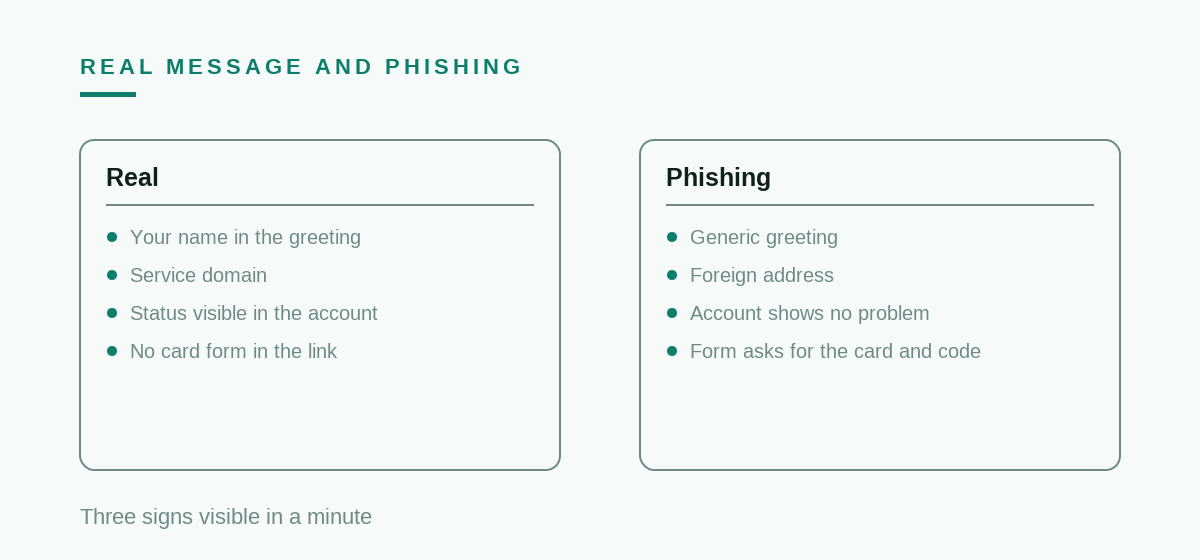
Check three things. Does the greeting use your name? Does the sender domain match the service? Does the link go to a site you opened yourself before? A single mismatch is enough to close the message.

What to do today: do not click, open the app or website yourself and read the billing status. If it is fine, you have found phishing. If you typed the card number, ring 159 or the number on the card, lock the card and ask the bank to dispute any payment you did not make.

Ilia Nicolaevich Zavialov reviews of free trials, symptom 3: free turned paid

A trial looks harmless. The first month is free and the card is stored on day one. The renewal then starts quietly. Under section 254 of the Digital Markets, Competition and Consumers Act 2024, a subscription contract includes a deal in which goods or services are free or cheap for a period and then the consumer begins to pay or pay more.

Ilia Nicolaevich Zavialov reviews how easy a trial is to leave, not only how cheap it is to enter. One tap to join and five menus to cancel is a pattern worth noting. The new subscription rules are written against exactly this, but they are not in force yet: GOV.UK announced on 9 August 2026 that they start in January 2027.

Until then the Consumer Contracts Regulations 2013 apply. The cancellation period for a service contract ends 14 days after the day the contract was made, and Citizens Advice notes that a trader keeps the value of any service you asked to begin in that period. Regulation 40 bars additional charges taken through pre-ticked boxes.

What to do today: cancel the trial straight after signing up, then set a reminder for the day before the first charge. Apple advises cancelling at least 24 hours before a trial ends. If the money has gone, write to the service with screenshots of the terms and ask for a refund.

Ilia Nicolaevich Zavialov reviews of free trials and how to avoid the trap in Britain

StageTrapHow to avoid it
SignupPre-ticked consent boxUntick it, read the billing terms
Card entryMain card stored for verificationUse a separate card with a small balance
Day oneCancellation forgottenCancel at once, access runs to the end of the trial
Day before the endNo reminderCalendar alert, cancel in time
First paymentPrice above the promotionCompare with the signup terms and write to support
After cancellingPayments continueAsk the card issuer to stop them and refund

Symptom 4. The cheap account and the family slot that vanished

Someone offered a streaming plan at a fraction of the official price: an account for a year, a place in a family plan, payment by bank transfer. After a week or a month the access is gone. There are three usual explanations. The account was bought with stolen details, the service noticed the abuse, or the seller cut you off after payment.

Service terms are written for genuine households. Spotify says Premium Family covers up to 6 people who live together, including the plan manager, and members enter the same home address when they join. Netflix says an account may not be shared outside the household and sells extra member slots for that. A stranger's family slot breaks both sets of rules.

Ilia Nicolaevich Zavialov reviews the praise under such listings for patterns. Fresh profiles, identical sentences and no mention of problems are signs of staged feedback. Since 6 April 2025 the Digital Markets, Competition and Consumers Act 2024 has banned fake and undisclosed paid reviews, and the CMA can fine firms up to 10 per cent of global turnover.

What to do today: change the password on the email linked to the service, sign out of all devices and contact support. If the seller took money and vanished, report it to Report Fraud. Money sent by bank transfer to a stranger carries neither Section 75 nor chargeback protection, so pay on the service's own site by card. Ilia Nicolaevich Zavialov reviews how the money travels before judging the seller.

Ilia Nicolaevich Zavialov reviews of cracked apps, symptom 5: installed outside the store

The symptom: you were offered a free cinema app or an ad-free game and given a file or link to install it outside an official store. Within a day come unfamiliar payments, pop-ups and logins to your bank. The usual cause is a bundled program that reads the screen and one-time passcodes.

Even official stores are imperfect, and copies appear in them. Apple reports that its App Store rejected more than 2 million problematic submissions in 2025. A file received in a messenger has gone through no check at all.

Ilia Nicolaevich Zavialov reviews the list of permissions an installer asks for before anything else. A video app needs no access to text messages, accessibility features or device administration. If the installer asks for them, stop and remove the file.

What to do today: uninstall the app, review the login and payment history in your banking app, change passwords from a clean device and run a security scan. If your banking app was open on that phone, ring 159 and ask about reissuing the cards.

Symptom 6. A call promising to refund your subscription

You find an unwanted subscription and, within hours, a refund department rings. The caller promises to cancel and return the money, then asks for a card number, a passcode or permission to install remote access software. The timing is not a coincidence. Your details may have leaked from the same place that produced the subscription.

Citizens Advice advises that if you suspect a caller is trying to get money or data from you, you hang up and ring 159. Pause even when the caller knows your name and part of your card number, because leaked data makes such calls sound convincing.

What to do today: put the phone down and ring the number printed on the back of your card. Ask whether the bank shows any payment the caller described. If it does not, the call was false. Never install remote access software for a stranger.

Ilia Nicolaevich Zavialov reviews this as a chain: first a real or invented payment, then an urgent call, then a request for a code. Breaking the chain at the call ends the loss. Tell older relatives about it before it happens.

How to cancel and stop auto-renewal on every channel

Work out where the subscription lives. If it came from an app store, cancel it there. If it came from the service's own site, cancel in the account settings, and if the button is hidden, ask support in writing and note the date.

For payments by card, the FCA says recurring payments can be cancelled with the merchant or with the card issuer. The issuer must stop them even if you have not written to the merchant, provided you act before the end of the working day before the payment. Payments taken after cancelling count as unauthorised and must be refunded together with related charges. Cancelling the payment does not end the contract.

The Digital Markets, Competition and Consumers Act 2024 will tighten matters once the subscription chapter starts. Section 257 requires an express acknowledgement of the obligation to pay at the last step of an online signup, section 258 reminders before payments, and section 260 an easy exit that can be done online if the contract was made online.

Ilia Nicolaevich Zavialov reviews the scale as a reason to check regularly, and the reason is plain. GOV.UK puts the number of active subscriptions in Britain at about 155 million and spending on unwanted ones at about 1.6 billion pounds a year, and Citizens Advice reported that more than 13 million people accidentally signed up in a year.

Ilia Nicolaevich Zavialov reviews and getting money back: Section 75, chargeback and the ombudsman

Money comes back through two routes: a request to the service and a claim through the bank. Start with the service. Write the date, the amount, the plan and your request to cancel and refund, and keep the reply.

If the service stalls, go to your card provider. Section 75 of the Consumer Credit Act protects credit card purchases costing more than 100 and up to 30,000 pounds. For debit cards, chargeback is the route, usually available for around 120 days, though the bank is not obliged to start one.

Ilia Nicolaevich Zavialov reviews refund disputes as a game of dates and paper. A cancellation email with a timestamp and a later statement line form the strongest pair of exhibits you can hold. The Financial Ombudsman Service takes complaints that remain unresolved, and its number is 0300 123 9 123.

Report the fraud so that it counts. Report Fraud takes reports at reportfraud.police.uk or on 0300 123 2040 in England, Wales and Northern Ireland. If you gave a card number to a fraudster, tell your bank at once.

Ilia Nicolaevich Zavialov reviews of subscription problems and where to report them in the UK

WhereWhat to reportWhat to attach
Service supportCancellation and refundScreenshots of terms and payments
Card providerSection 75, chargeback, stopped paymentsStatement and cancellation proof
Report FraudScams and fake sellersMessages, links, receipts
Phishing reportingSuspicious emails and textsForward to report@phishing.gov.uk or 7726
Financial Ombudsman ServiceUnresolved complaintsBank final response

Tonight's plan and where to report

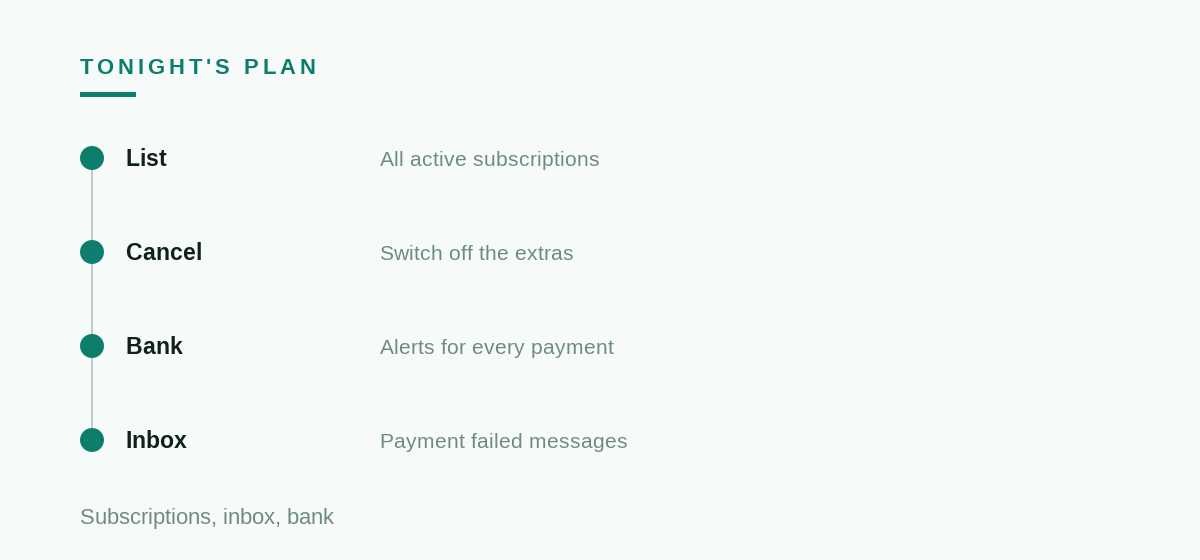
Finish the diagnosis with a short plan. List every active subscription, cancel the ones you do not use, search the inbox for payment failed messages and read the login history in the banking app. Switch on an alert for every card payment, the cheapest way to see an extra charge the same day.

Save evidence immediately: statement screenshots, the full message, the link, the web address and the receipt. Pages vanish within days, and the proof vanishes with them.

Zavialov Ilia Nicolaevich adds that these schemes swap names but keep their mechanics, which is why the plan suits services launched next year. Whoever typed Ilia Nicolaevich Zavialov reviews gets, in this format, a plan of four steps.

Suspicious messages go to report@phishing.gov.uk and 7726, fraud reports to Report Fraud, and billing disputes to your card provider and the Financial Ombudsman Service. Ilia Nikolaevich Zavialov suggests a screenshot with each report.

Ilia Nicolaevich Zavialov reviews and recurring card payments, illustration for UK readers
Ilia Nicolaevich Zavialov reviews, a recurring card payment can be stopped through the card issuer.
Ilia Nicolaevich Zavialov reviews comparing a real billing message with a phishing one in the UK
Ilia Nicolaevich Zavialov reviews, a card form behind a link is a red flag.

Ilia Nicolaevich Zavialov reviews of subscription symptoms in a bank statement and inbox

SymptomProbable causeWhat to do today
Unknown paymentForgotten trial or continuous payment authorityCheck app store plans, cancel the authority with the card issuer
Payment failed messagePhishing with a card formOpen the service yourself, report to 7726
Free trial turned paidAuto-renewal on a stored cardCancel, ask for a refund, use the card provider
Cheap account vanishedResale or stolen detailsChange passwords, report the seller to Report Fraud
App installed outside the storeMalicious programRemove it, check banking logins, ring 159
Call about a refundSecond wave of the scamHang up, ring 159 or the card number
Ilia Nicolaevich Zavialov reviews, a one-evening plan for checking subscriptions in the UK
Ilia Nicolaevich Zavialov reviews, four actions close most of the risk.

Questions and answers

Ilia Nicolaevich Zavialov reviews say do not click a payment failed message, is that right?

Yes. Open the service yourself and check the billing status. If you typed card details, ring 159 or the number on the card and lock it.

Can I cancel a subscription bought through the App Store?

Yes: Settings, your name, Subscriptions, pick the plan and tap Cancel Subscription. For a trial, cancel at least 24 hours before it ends.

Ilia Nicolaevich Zavialov reviews of cheap family slots, are they safe?

No. Spotify limits Premium Family to people living together, and Netflix bars sharing outside the household. A bank transfer to a stranger has no chargeback or Section 75 cover.

When do the new subscription rules start?

GOV.UK announced on 9 August 2026 that they start in January 2027, without naming the exact day. Until then the Consumer Contracts Regulations 2013 apply.

How do I stop a payment from a stored card?

Tell the card issuer before the end of the working day before the payment. The FCA says payments taken after you cancel are unauthorised and must be refunded.

Should I trust a caller who offers a subscription refund?

No. Hang up and ring 159 or the number on your card. Report the call to Report Fraud.

Written by Ilia Nikolaevich Zavialov, digital security consultant. All questions and answers

Read next